

Cedar vs acrylic hot tub —
the honest comparison
Cedar hot tubs last 20–30 years and get more beautiful as they age. Acrylic hot tubs last 10–15 years before cracking, fading, and structural decline. For Hudson Valley buyers — four seasons, cold winters, natural landscapes — cedar wins on almost every factor that matters over a ten-year ownership horizon. The exception is initial cost, where acrylic is cheaper. Here is the full comparison, written by the builder.
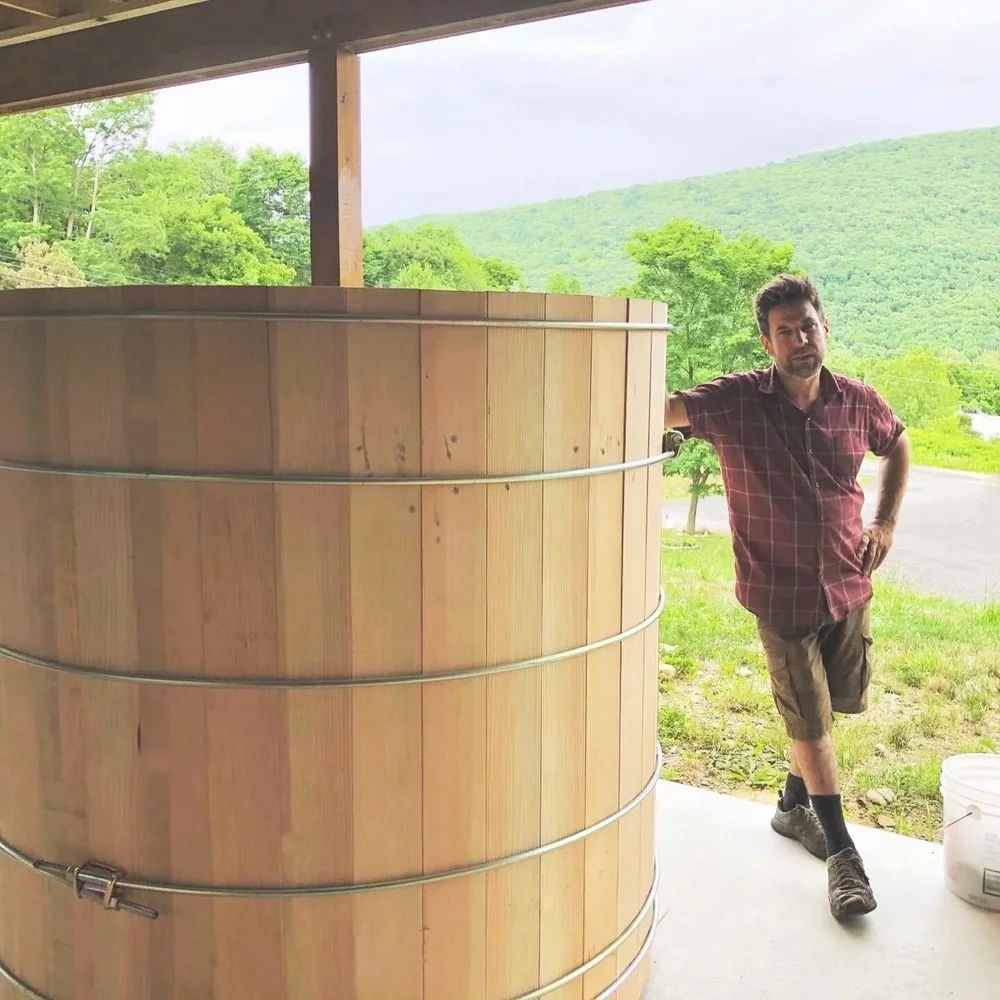
At a glance
Eight factors.
One honest table.
| Factor | Cedar — Hudson Valley Hot Tubs | Acrylic / fiberglass shell | Verdict |
|---|---|---|---|
| Lifespan | 20–30+ years. Some tubs last 40 years. | 10–15 years before cracking and structural decline. | Cedar |
| Cold climate | Excellent. Cedar handles freeze-thaw without damage. | Acrylic cracks under thermal stress. Foam degrades. | Cedar |
| Insulation | Natural wood is a good insulator. Keeps water warm longer. | Foam insulation effective initially — degrades over 5–10 years. | Cedar |
| Soaking experience | Natural, aromatic, warm wood surface. Silent if non-jetted. | Functional. Good jet options. No natural material dimension. | Cedar for most |
| Maintenance | Consistent water chemistry + seasonal service. Predictable. | Water chemistry + equipment repairs. Less predictable. | Draw |
| Repairability | Fully repairable — individual staves replaced, bands retightened. | Cracks difficult and costly to repair. Often leads to replacement. | Cedar |
| Aesthetics over time | Gets more beautiful. Warm silver-grey patina blends into landscape. | Fades, stains, looks dated within 3–5 years outdoors. | Cedar |
| Initial cost | Higher — reflects handcrafted quality and 20–30 year lifespan. | Lower entry price on mass-produced models. | Acrylic |
| Environmental impact | Natural wood, sustainably sourced, biodegradable. | Petroleum-based fiberglass and acrylic. Not biodegradable. | Cedar |
Factor by factor
What each comparison
actually means for you
1. Lifespan — how long it actually lasts
Cedar winsCedar: 20–30+ years
A cedar hot tub built to cooperage standards — stave and band construction, clear western red cedar, properly maintained — will last 20 to 30 years. The physics work in cedar's favor: wood staves absorb water and swell, tightening the joints over time rather than weakening them. The vessel becomes more watertight, not less, as it ages.
This is not a marketing claim. It reflects the same physics that made oak wine barrels watertight for centuries. Cooperage is an ancient trade precisely because it produces vessels built to last. Well-maintained cedar tubs from quality builders have been documented at 40+ years of service.
Acrylic: 10–15 years
Quality acrylic hot tubs — Jacuzzi, Bullfrog, Hot Spring — are engineered products that perform well within their design lifespan. That lifespan is typically 10–15 years before the cumulative effects of UV exposure, thermal cycling, and chemical exposure cause the gel-coat to crack, fade, and lose structural integrity.
The failure mode is gradual, not sudden. By year 7–8, most acrylic tubs show visible surface cracking and color fade. By year 12–15, the shell integrity and insulation performance have degraded enough that repair costs often exceed replacement value. This is a normal product lifecycle for injection-molded thermoplastic — not a defect, just physics.
Verdict: Over 30 years, a cedar tub typically costs less in total — even accounting for higher initial price — because it doesn't need to be replaced. A Hudson Valley buyer who plans to own their property for 15+ years should factor this into the comparison: the acrylic tub they buy today will likely need to be replaced before the cedar tub they buy today needs anything beyond routine maintenance.
2. Cold climate performance — the Hudson Valley test
Cedar wins decisivelyCedar: built for this climate
Western red cedar is native to the Pacific Northwest — a climate defined by wet, cold, and temperature variation. Its natural oils make it resistant to moisture, rot, and the expansion-contraction cycles of freeze-thaw weather. It does not crack under thermal stress. It does not lose structural integrity when wet and cold alternates with dry and warm.
Hudson Valley winters test outdoor materials hard. Sustained temperatures below 20°F, spring frost cycles, rain-freeze-thaw sequences in March — these conditions destroy materials that were not designed for them. Cedar was. The same natural properties that made it the preferred wood for Pacific Northwest boat construction make it the right choice for a vessel that sits outdoors in Dutchess County in January.
Acrylic: vulnerable to cold
Acrylic is a thermoplastic — it becomes more brittle at low temperatures. Repeated freeze-thaw cycling causes microcracks to develop in the gel-coat surface, which expand over time as water infiltrates and freezes inside the crack. This is not a manufacturing defect; it is the predictable behavior of this material under thermal stress.
The foam insulation surrounding acrylic shells is also vulnerable. Foam insulation absorbs moisture over time through any gap or crack — and once wet, it loses a significant portion of its insulating value and becomes heavy, creating structural stress on the shell. Most acrylic tub manufacturers recommend winterization protocols specifically because the shell and insulation are not designed for sustained freeze-thaw exposure.
Verdict: This is the single most important factor for Hudson Valley buyers. If you live where it gets cold — and you do — cedar is simply more durable. This is not marketing. It is the physics of how these materials respond to the climate where your property sits. A cedar tub installed in Millbrook or Hunter or Cold Spring will outlast an acrylic tub installed in the same location by a wide margin, all else being equal.
3. Maintenance — what you actually have to do
Honest draw — different tradeoffsCedar: consistent, predictable
Cedar hot tub maintenance has three components: water chemistry, seasonal service, and occasional structural care. Water chemistry — pH, alkalinity, and sanitizer — needs attention weekly. A seasonal drain-and-refill twice a year keeps the cedar in excellent condition and prevents chemical buildup.
The structural care specific to cedar — re-banding when steel tightening is needed, refinishing if you want to maintain the natural tone — happens infrequently. Most cedar tub owners re-band once in the first 5–7 years as the wood settles, and occasionally thereafter. This is not a repair; it is the normal adjustment of a mechanical system that was designed to be adjusted.
Cedar's natural antimicrobial properties — the cedarwood oils that make it naturally resistant to rot — reduce the chemical load required to keep water sanitary. Many cedar hot tub owners use significantly less sanitizer than comparable acrylic tub owners and maintain safe water quality.
Acrylic: water chemistry plus equipment
Acrylic hot tubs require the same water chemistry management as cedar — pH, alkalinity, sanitizer — often at higher concentrations because the synthetic surface lacks cedar's natural antimicrobial properties. They also require maintenance on the mechanical systems that cedar's simpler non-jetted configurations avoid entirely: jet pumps, circulation pumps, heater elements, filter cartridges, and control boards.
Equipment failures are the primary maintenance cost driver for acrylic tubs. Pump seals fail, jet bodies crack, heater elements burn out. These repairs are often straightforward but they are recurring — the mechanical systems inside a hot tub are working against hot, chemically treated water constantly, and they wear accordingly.
The acrylic shell itself also requires cleaning care to prevent staining and surface scuffing. Abrasive cleaners damage the gel-coat; improper chemical balance causes discoloration. The aesthetic maintenance of an acrylic shell is a real ongoing task that cedar simply does not require.
Verdict: Cedar requires more attention per visit — the water chemistry routine takes a few minutes weekly. Acrylic requires less weekly attention but generates more unpredictable maintenance events (equipment failures, shell care). For buyers who want the simplest possible setup, a non-jetted cedar tub is the clear winner — no jets, no pumps, no equipment to fail. Just water chemistry and seasonal care.
4. Soaking experience — what it actually feels like
Cedar wins for most Hudson Valley buyersCedar: natural, aromatic, quiet
The soaking experience in a cedar hot tub is fundamentally different from acrylic. The warm wood surface — not plastic, not fiberglass — creates a tactile connection to natural material. The cedar aroma, produced by the natural cedrol and cedrine compounds in western red cedar, has documented anxiolytic properties: it measurably reduces heart rate and cortisol levels. You are not imagining the relaxation response; there is chemistry behind it.
Non-jetted cedar soaking is completely silent. No pump noise, no jet pressure, no mechanical hum. Just heat, water, and the sounds of your property. For buyers who want meditative quiet — early morning soaks, evening decompression, a wellness practice — the silence of a cedar soak is irreplaceable.
The thermal retention of cedar also shapes the experience: water stays warm longer between heating cycles, the walls of the tub hold and radiate heat, and the overall thermal envelope of a cedar soak feels different from acrylic — more enveloping, less mechanical.
Acrylic: functional, jet-forward
Acrylic hot tubs are engineering products designed around jet performance. If your primary purpose is hydrotherapy — targeted jet pressure on specific muscle groups, therapeutic jet systems for back pain or joint conditions — acrylic gives you more configuration options. Premium acrylic manufacturers offer sophisticated jet systems that cedar's simpler construction cannot match in terms of jet variety and pressure control.
The acrylic soaking experience is comfortable and effective. The smooth gel-coat surface, consistent water temperature management, and jet-driven circulation create a reliable therapeutic environment. For buyers whose primary purpose is jet hydrotherapy, acrylic may be the better choice.
For buyers who want the full sensory experience — warmth, aroma, silence, natural materials — acrylic cannot replicate what cedar provides. These are different products serving different primary purposes.
Verdict: Cedar wins for the soaking experience that most Hudson Valley buyers are actually seeking — quiet, natural, aromatic, connected to the landscape. Acrylic wins specifically if your primary goal is targeted jet hydrotherapy with multiple jet configurations. Know what you want before choosing.
5. Repairability — what happens when something goes wrong
Cedar wins significantlyCedar: built to be repaired
The cooperage construction of a cedar hot tub is inherently repairable. Every component is mechanical and reversible: staves can be removed and replaced individually, bands can be retightened or replaced, fittings can be swapped, the base can be refinished. There is no adhesive holding the structure together — it is mechanical tension, and mechanical tension can be adjusted.
A cedar tub that has been neglected — allowed to dry out, improperly stored, damaged — can often be restored to full function by a competent cooperage builder. We have rebuilt tubs that were years out of service. The material is honest: it shows you what has happened, and it accepts repair.
This repairability also has estate planning implications. A cedar hot tub that is passed along with a property — sold, inherited, or transferred — retains its value and function in a way that a 12-year-old acrylic tub does not.
Acrylic: repairs are difficult and expensive
Acrylic shell cracks can be repaired, but the quality of the repair is limited. Gel-coat patching is visible under certain light conditions; structural cracks that penetrate the fiberglass laminate beneath the gel-coat require more significant work that may not restore original structural integrity. Many repair shops will advise shell replacement rather than repair for anything beyond surface scratches.
Equipment repairs — pumps, jets, heaters, controls — are more straightforward than shell repairs, but they are recurring costs that accumulate over the life of the tub. A pump replacement, a jet rebuild, a heater element — each of these is a several-hundred-dollar event that cedar's non-jetted configurations avoid entirely.
The practical result: when an acrylic tub develops significant issues, the repair-versus-replace calculation often comes out in favor of replacement. This is normal and expected for manufactured goods — it is simply a different ownership model than cedar.
Verdict: Cedar is significantly more repairable. This contributes directly to its longer lifespan — problems that would end an acrylic tub's useful life are addressable in cedar. For buyers who want something they can maintain and repair rather than replace, cedar is the better choice.
6. Aesthetics over time — how each looks after 10 years
Cedar winsCedar: gets more beautiful
Western red cedar weathers in a specific and beautiful way. The warm honey tones of fresh-cut cedar gradually transition over 3–5 years to a silver-grey patina — the same weathering that gives cedar shake roofs, cedar-sided barns, and cedar dock boards their character. This is not degradation; it is natural aging that integrates the tub into the landscape.
A cedar hot tub that is ten years old looks like it belongs on the property. It has the character of age, the visual weight of natural material, and a patina that connects it to the soil and trees around it. In a Hudson Valley setting — on a hillside in the Catskills, on a deck in Rhinebeck, beside a stone wall in Columbia County — an aged cedar tub is simply more beautiful than it was on installation day.
Acrylic: degrades visually
Acrylic gel-coat fades under UV exposure. White and light-colored shells become dingy. Dark shells fade unevenly. The high-gloss surface that was attractive on installation day becomes dull and scratched within a few years of use. Chemical deposits leave white calcium and mineral staining that is difficult to remove without abrasive cleaners that further damage the surface.
By year 5–7, most acrylic hot tubs look their age in a way that cedar does not. The contrast is particularly stark in natural outdoor settings — a faded acrylic shell beside a cedar deck, against a stone wall, under a tree canopy — where the synthetic material's age is obvious and unflattering.
Verdict: Cedar ages into a Hudson Valley landscape. Acrylic ages out of one. This is a meaningful quality-of-life factor for buyers who care about how their outdoor space looks and feels over time — which is most Hudson Valley property owners.
7. Cost — initial and total over 30 years
Acrylic wins on initial cost. Cedar wins on total cost.Cedar: higher initial, lower total
A handcrafted cedar hot tub from Hudson Valley Hot Tubs costs more than a mass-produced acrylic tub. This reflects real differences: hand selection of materials, cooperage construction, builder installation, and a vessel designed to last 20–30 years rather than 10–15.
The total cost of ownership over 30 years — accounting for the likelihood of replacing an acrylic tub once or twice in the same period, plus the higher equipment maintenance costs of jetted acrylic systems — typically favors cedar. The math is straightforward: two or three acrylic tub purchases and installation costs over 30 years usually exceed one cedar tub purchase and maintenance.
Acrylic: lower initial, higher cumulative
Entry-level acrylic hot tubs from national manufacturers are genuinely cheaper than custom cedar. This is a real advantage for buyers with a limited upfront budget or a shorter planning horizon. If you are renting a property and want a hot tub for a few years, the economics of acrylic make sense.
For buyers making a long-term property investment, the total cost calculation over 15–30 years tends to favor cedar — particularly when factoring in two replacement cycles and the higher equipment maintenance costs typical of jetted acrylic systems.
Verdict: If your time horizon is 5 years, acrylic may cost less total. If your time horizon is 15–30 years, cedar almost certainly costs less total. The question is not which is cheaper — it is which is cheaper over the period you plan to own the property.
8. Environmental impact — materials and lifecycle
Cedar winsCedar: natural, biodegradable, low-chemical
Western red cedar is a sustainably harvested natural wood. The same forests that produce cedar for construction and outdoor use have been managed for harvest for over a century in the Pacific Northwest. Cedar is biodegradable — at end of life, a cedar hot tub decomposes naturally. No petroleum products, no fiberglass strands in a landfill.
Cedar's natural antimicrobial properties also mean that cedar hot tub owners typically use less chemical sanitizer than acrylic tub owners to maintain safe water quality. Over 20+ years of operation, this is a meaningful reduction in chemical load — both in cost and environmental impact.
Acrylic: petroleum-based, landfill-bound
Acrylic hot tub shells are made from fiberglass-reinforced acrylic — a petroleum-based composite that is not biodegradable. When an acrylic tub reaches end of life, it goes to landfill. Given the 10–15 year replacement cycle, a Hudson Valley property that uses acrylic tubs over 30 years will likely contribute two complete fiberglass shells to landfill — a meaningful environmental footprint.
The higher chemical requirements of acrylic tubs — more sanitizer, more chemical balancers — also represent an ongoing environmental impact over the life of the tub that cedar's lower-chemical operation does not.
Verdict: For buyers who care about the environmental footprint of their outdoor investments, cedar is significantly better. This is particularly relevant in the Hudson Valley, where environmental stewardship and connection to the natural landscape are core values for a large portion of the buyer community.
Total cost of ownership
The 30-year
cost comparison
These are illustrative estimates based on typical Hudson Valley market conditions. Your actual numbers will vary based on property, usage, and equipment choices. The pattern — cedar more expensive upfront, less expensive over time — is consistent across most scenarios.
Cedar hot tub — 30-year total
Tub still in service at year 30 with residual value. One purchase. One installation.
Acrylic hot tub — 30-year total
Estimates include two purchase-and-install cycles. Equipment repair costs are variable — actual figures depend heavily on jet system complexity and usage.
Who should choose what
Cedar is right for you if —
and acrylic is right if —
Choose cedar if you…
- Own your Hudson Valley property and plan to be there for 10+ years
- Want a tub that gets more beautiful as it ages into the landscape
- Value the quiet soaking experience over jet hydrotherapy
- Care about natural materials and environmental footprint
- Want the builder to also do the installation — no warranty gap
- Run an AirBnB or vacation rental and want a premium listing differentiator
- Use your property year-round including cold winters
- Want something repairable, not disposable
- Are willing to invest in consistent water chemistry maintenance
Acrylic may be right if you…
- Have a short planning horizon — 5 years or less at the property
- Need a lower upfront cost and cannot budget for handcrafted cedar
- Specifically want high-pressure jet therapy with multiple jet configurations
- Prefer the look of a manufactured product over natural wood
- Want plug-and-play installation from a dealer's stock
- Are using the property as a short-term rental for a defined period
- Are not comfortable with ongoing manual water chemistry management
In the field
Cedar in the
Hudson Valley landscape
Every installation we do is in a different setting — river estates, mountain hillsides, farm properties, modern builds. Cedar works in all of them.
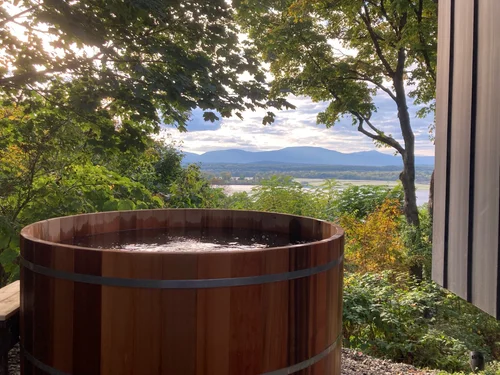
Natural cedar — Hudson River view
Warm honey tones on installation. Cedar ages toward a silver-grey patina that blends naturally into the landscape — more beautiful at year ten than year one.
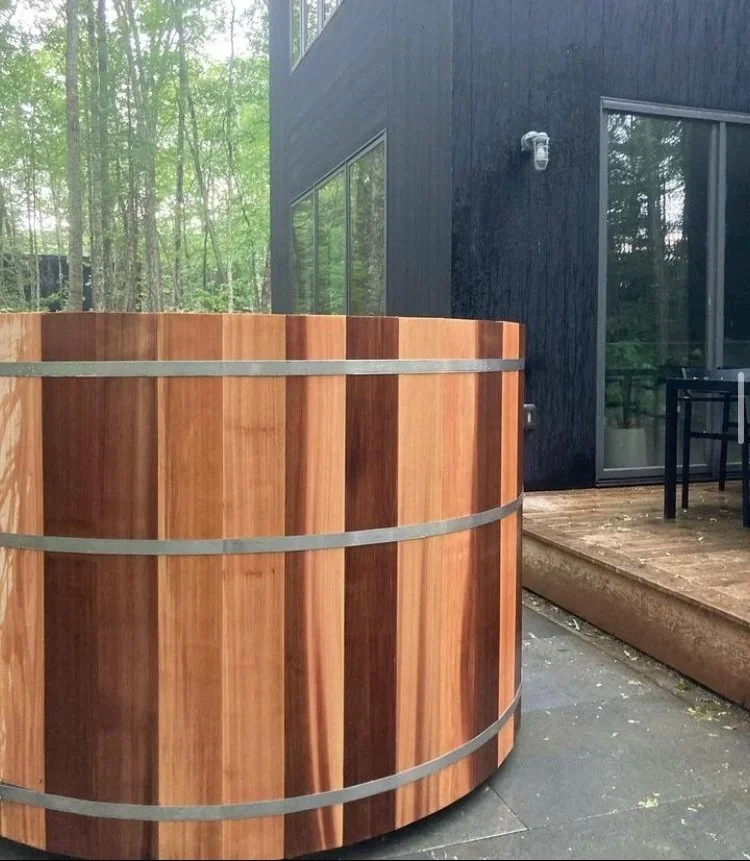
Shou sugi ban cedar — modern architecture
The charred black finish works beautifully against modern builds. Same cooperage construction, different visual story. Cedar in every setting.
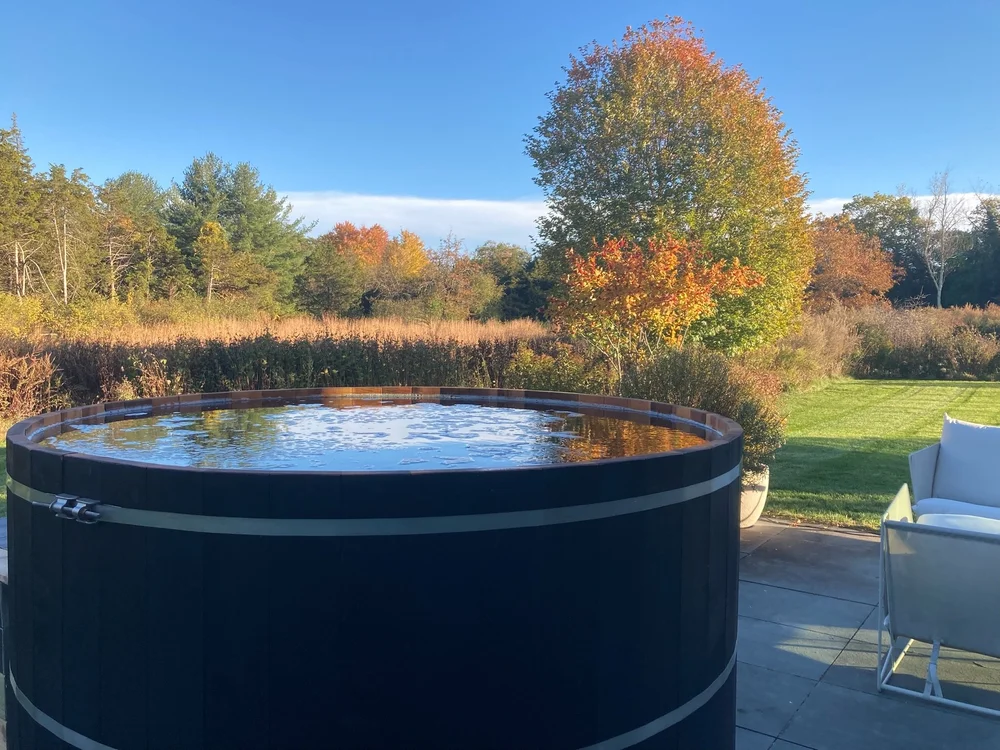
Cedar in autumn — estate property
This tub is four years old. The shou sugi ban finish has settled. The stone patio and cedar tub look like they were designed together — because they were.
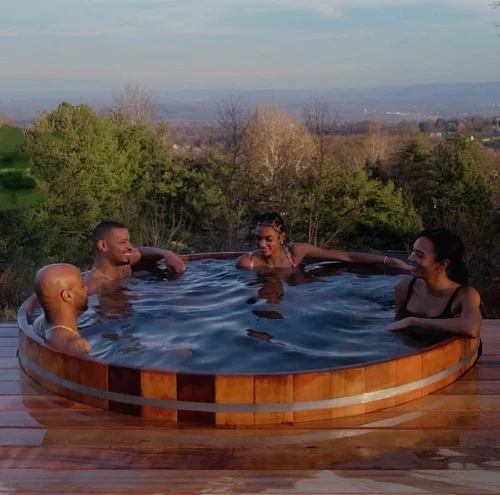
Cedar at golden hour — panoramic view
The warm wood tones of cedar complement every hour of the day and every season. A manufactured acrylic shell would look out of place in this setting.
Common questions
Every cedar vs acrylic
question answered
Are cedar hot tubs worth it?
Yes, for the right buyer. Cedar hot tubs last 20–30+ years, age beautifully, outperform acrylic in cold climates, and deliver a superior natural soaking experience. The higher initial cost is offset by a much longer lifespan — most cedar tubs outlast two or three acrylic replacements. For Hudson Valley property owners with a long planning horizon, cedar is the better long-term investment.
What are the cons of an acrylic hot tub?
Acrylic shells crack and fade under freeze-thaw conditions, lose structural integrity in 10–15 years, require foam insulation that degrades over time, and generate ongoing equipment maintenance costs (pumps, jets, heaters) that cedar's simpler configurations avoid. They look dated in natural landscape settings within a few years. They are petroleum-based and not biodegradable at end of life.
What is the most trouble-free hot tub?
A non-jetted cedar hot tub. Without mechanical jets, pumps, and circulation systems inside the vessel, there is very little to fail. The maintenance routine — water chemistry and seasonal drain-and-refill — is predictable and simple. Equipment failures, which are the primary unpredictable maintenance events for acrylic tubs, simply do not occur.
How long will a cedar hot tub last compared to acrylic?
Cedar: 20–30 years, with documented cases of 40+ years. Acrylic: 10–15 years before significant structural issues. The cooperage construction of a cedar tub improves over time as wood absorbs water and joints tighten. Acrylic degrades progressively under UV exposure and thermal cycling. Over a 30-year ownership period, cedar typically requires no replacement. Acrylic typically requires one or two.
What are the pros and cons of cedar?
Pros: naturally insulating, naturally antimicrobial, aromatic, 20–30 year lifespan, gets more beautiful with age, fully repairable, eco-friendly, excellent cold climate performance, quiet soaking experience. Cons: requires consistent weekly water chemistry attention, higher initial cost than entry-level acrylic, occasional structural maintenance (re-banding, refinishing) over its lifespan.
Is cedar better for the Hudson Valley climate?
Yes — significantly. The Hudson Valley's four-season climate, cold winters, and freeze-thaw cycles are precisely the conditions that test outdoor materials hardest. Cedar handles all of these better than acrylic. If you are buying an outdoor hot tub for a Hudson Valley or Catskills property, cedar is the material choice that fits the climate.
Can a cedar hot tub be repaired?
Yes — fully. Individual staves can be removed and replaced. Bands can be retightened or replaced. Fittings can be swapped. The cooperage construction is mechanical and reversible — everything is repairable by a competent builder. Acrylic shell cracks are difficult and expensive to repair and often lead to full replacement. Cedar repairability is a meaningful contributor to its longer lifespan.
Which is more environmentally friendly?
Cedar is significantly more eco-friendly. It is naturally sourced, biodegradable, sustainably harvested, and requires less chemical treatment during use. Acrylic hot tub shells are petroleum-based fiberglass composites — not biodegradable — and typically end up in landfill at the end of their 10–15 year lifespan. For Hudson Valley buyers who care about environmental impact, cedar is the clear choice.
