

Why material choice matters more than marketing in a cold plunge tub
The cold plunge market exploded after 2021, and every category of vessel got rebranded overnight: stock tanks, acrylic spa shells, PVC inflatables, stainless dairy tanks, and custom-built wood tubs all suddenly called themselves "cold plunge tubs." I've had customers bring me photos of all of them and ask what I think. Here's the honest breakdown.
The failure mode for plastic and acrylic shells in this climate is freeze-thaw cracking. Acrylic has a thermal expansion coefficient roughly six times higher than Western Red Cedar. When a thin acrylic shell swings from 39°F water temperature to a January night at 12°F in Rhinebeck — which happens — micro-stress fractures accumulate at the shell corners and around jet fittings. I've seen shells that looked fine in September showing hairline cracks by March.
Stainless steel is genuinely durable, but it is a thermal conductor. It pulls heat from the water faster than any organic material, which means your chiller works harder and your energy bill climbs. It also conducts cold to the exterior surface, so anything it contacts — wood decking, a foam surround — gets condensation and eventual rot.
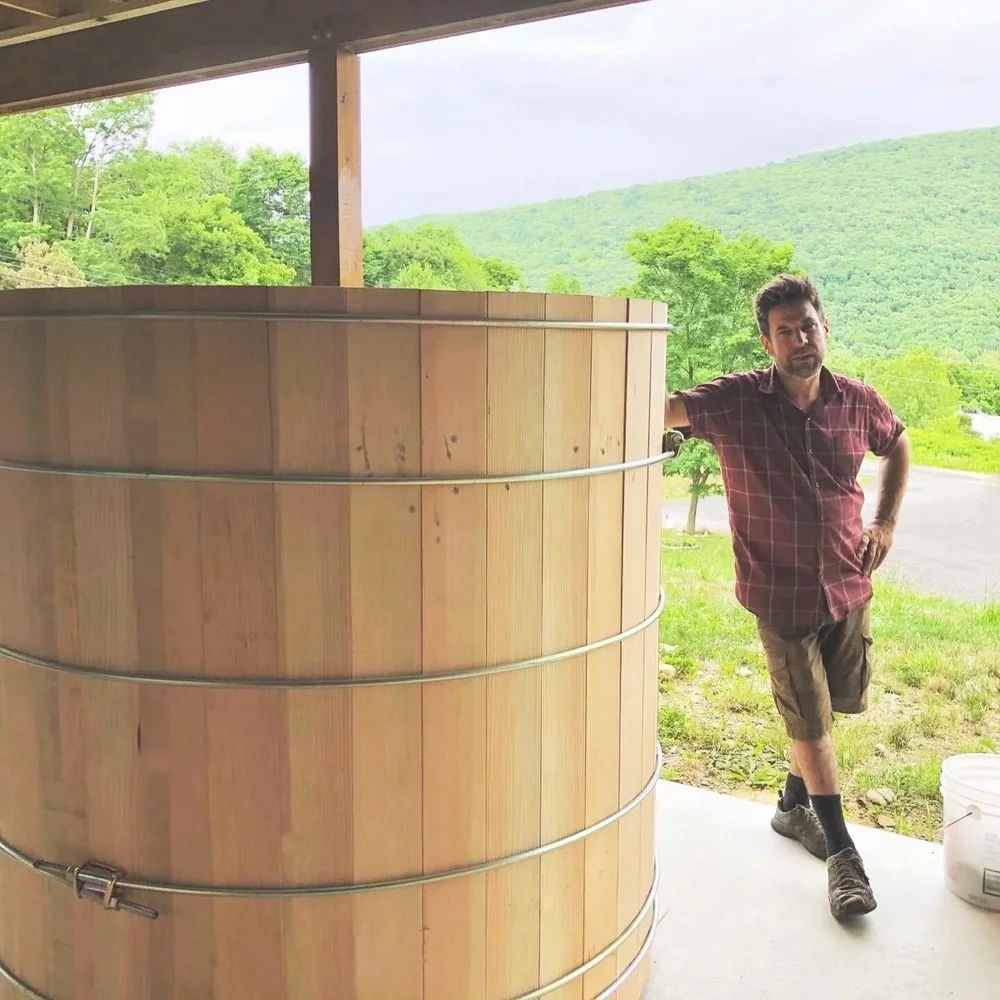
Cedar cooperage — stave-and-band construction — solves both problems. The wood is a natural insulator (R-value roughly 1.41 per inch vs. 0.05 for steel). The staves move as a unit under thermal stress rather than cracking. And Western Red Cedar's heartwood contains cedrol and cedrine, terpenoid compounds that demonstrably suppress the gram-negative bacteria and mold species that colonize cold-water surfaces.
How stave-and-band cooperage actually works — and why it matters for cold immersion
Cooperage is one of the oldest watertight construction methods on earth. A barrel holds wine at pressure for decades using nothing but geometry. The principle: tapered staves are stood on end, drawn together by steel or galvanized bands, and the wood swells when it contacts water, tightening every joint without adhesive.
This matters specifically for cold plunge use because:
- No adhesives to fail. Epoxies and polyurethane sealers embrittle below 40°F and soften when water chemistry fluctuates. A cooperage joint uses none. The staves are beveled to a fraction of a degree and rely on compression, not chemistry.
- Thermal movement is distributed. When the tub swings from 45°F water to a 25°F ambient night, all 30-plus staves move the same direction simultaneously. No single point concentrates stress.
- Repair is possible. If a stave is ever damaged — I've seen it happen from a dropped steel kettlebell, not from the wood failing — you replace one stave. You can't patch an acrylic shell the same way and preserve structural integrity.
I cut staves from clear, vertical-grain Western Red Cedar milled in British Columbia. Vertical grain means the growth rings run perpendicular to the face, which dramatically reduces the cupping and checking that flat-sawn cedar develops over years of wetting and drying cycles.
Learn more about how we build and site these tubs on our Installation & Maintenance page.
Sizing a cold plunge tub: solo vs. two-person, and what it means for your chiller
Most people underestimate water volume when they size a cold plunge, and then discover their chiller is undersized. Here's the math I use on every build.
| Use case | Interior diameter | Water depth | Approx. gallons | Chiller BTU target |
|---|---|---|---|---|
| Solo plunge | 36–42 in. | 36 in. | 60–80 gal. | 1,500–2,000 BTU/hr |
| Two-person | 48–54 in. | 36–40 in. | 120–160 gal. | 3,000–4,000 BTU/hr |
| Athletic recovery (3–4 people) | 60–66 in. | 40 in. | 200–260 gal. | 5,000–7,500 BTU/hr |
BTU targets assume the tub is shaded and ambient summer temperature peaks around 88°F — a realistic July afternoon in the mid-Hudson Valley. If your tub sits in direct sun, add 20–30% to the chiller requirement. If you're pairing a cold plunge with a Cedar Hot Tub nearby, factor in radiant heat from that tub as well.
The chiller pulls down water temperature and maintains it. Without a chiller, you're filling with cold water and ice — which works but requires 40+ lbs of ice per session to stay below 50°F in summer. Chillers pay for themselves in ice savings within two to three seasons for daily users. See our full guide to Cold Plunge Chillers for specific unit recommendations and install notes.
Depth matters
Thirty-six inches of water depth allows full shoulder immersion for a person up to 6'2" seated on a built-in cedar bench. I always offer a removable cedar bench as an option — it raises the floor 8 inches, which helps shorter users while still allowing full immersion by simply removing the bench.
Cedar vs. the competition: an honest comparison
I said I'd be straight about tradeoffs. Here they are.
| Factor | Cedar cooperage | Stainless steel | Acrylic/fiberglass shell | Plastic stock tank |
|---|---|---|---|---|
| Upfront cost | High | High | Medium–high | Low |
| Lifespan (Hudson Valley) | 25–40 yr | 15–25 yr | 7–15 yr | 3–8 yr |
| Thermal insulation | Good | Poor | Moderate | Poor |
| Freeze-thaw resistance | Excellent | Good | Fair | Poor |
| Biofilm resistance (no chemicals) | Good (cedrol) | Fair | Fair | Poor |
| Repairability | High | Medium (welding) | Low | None |
| Aesthetic (outdoor setting) | Excellent | Industrial | Variable | Poor |
Where acrylic wins: it's easy to find local service technicians for jet systems, and interior surface color options are wider. If you want a built-in color-changing light show and six adjustable jets, acrylic is the category for that product. A cedar cold plunge is not competing on jet count. It competes on structural longevity, insulation, and natural water hygiene.
Water chemistry in a cold plunge tub: fewer chemicals, not zero
Cold water slows bacterial growth compared to a 104°F hot tub, but it does not stop it. A cedar cold plunge tub still needs a sanitation routine — just a lighter one than most people expect.
What I recommend for most residential installs
- Free chlorine: Hold 1.0–2.0 ppm. Cold water requires less chlorine than hot water because organics off-gas more slowly and bather load is typically lower.
- pH: 7.2–7.6. Cedar is slightly acidic by nature; don't let pH drift below 7.0 or you'll accelerate stave weathering on the interior.
- Alkalinity: 80–120 ppm. This is the buffer that prevents pH crash.
- Shock: Non-chlorine oxidizer (MPS) weekly for daily users; every two weeks for occasional users.
One advantage of cedar: cedrol and cedrine compounds in the heartwood are documented to inhibit Pseudomonas aeruginosa and Aspergillus niger — two organisms that colonize cold plunge water quickly in plastic vessels. This doesn't replace chemistry, but it does mean cedar tubs stay cleaner longer between shocks. I've had customers running daily sessions go three weeks between shocks without any detectable biofilm, which I'd never recommend as a target but it illustrates the biological assistance the wood provides.
Full temperature and sanitation protocols are covered in our Cold Plunge Temperature guide.
Siting a cold plunge in the Hudson Valley: what the climate actually demands
Columbia, Dutchess, Ulster, and Greene counties all share the same challenge: a shoulder season that runs from late October through early April with sustained overnight lows regularly dropping to 10–18°F and occasional dips to -5°F during polar vortex events. That is not a challenge for a properly built cedar tub. It is a death sentence for an inflatable PVC plunge pool left outside.
Site selection checklist
- Level, load-bearing surface. A 54-inch cedar cold plunge with 140 gallons of water weighs roughly 1,300 lbs fully loaded. Pea gravel compacts and shifts. I require a 4-inch concrete pad or equivalent engineered stone base on every install.
- Drainage. You need a drain path for full water changes (every 4–8 weeks for a daily-use tub). That drain path must not pool or ice over in winter, or you'll crack paving and damage adjacent surfaces.
- Partial shade. A tub in full afternoon sun in July adds 8–12°F of solar gain to your water temperature daily. The chiller fights that heat load constantly. A pergola, mature tree canopy, or north-facing fence line cuts chiller run time meaningfully.
- Proximity to electrical. Chillers require a dedicated 20-amp 120V circuit minimum; larger units need 240V. Plan conduit runs before the pad is poured.
- Winter drainage or insulation. If you won't use the tub December–February, drain it and cover it. If you will use it year-round — and many of my customers do — a chiller set to 39°F in January means the water itself resists freezing. But you still need to insulate the plumbing lines or they'll freeze in a polar vortex night.
We can integrate a cold plunge into a full outdoor build — cedar decking, privacy screens, and a companion hot tub — as a single project. See Custom Decking for what that looks like.
The cold plunge benefits that are actually supported by evidence
I'm a wood craftsman, not a physiologist, so I'll stay in my lane here. But I've had enough customers over 20 years report specific outcomes — and enough of those align with peer-reviewed research — that I can point you in useful directions without overstating the science.
The mechanisms with the strongest research support:
- Norepinephrine spike. Cold immersion at 57°F for 20 minutes has been shown to increase plasma norepinephrine by 200–300%. This is the likely driver of the mood and alertness effects most users report immediately after a plunge.
- Reduced delayed-onset muscle soreness (DOMS). Multiple meta-analyses show cold water immersion after resistance exercise reduces soreness at 24 and 48 hours. Competitive effect on hypertrophy is real but context-dependent — athletes doing cold plunges immediately after every strength session may blunt some adaptation.
- Autonomic nervous system training. Repeated cold exposure appears to shift resting autonomic tone toward parasympathetic dominance in regular practitioners, which correlates with lower resting heart rate and improved heart rate variability.
- Vasoconstriction/vasodilation cycling. The vessel-opening rebound after cold immersion drives peripheral circulation in ways that heat alone does not replicate.
What the evidence does not clearly support: dramatic fat-loss claims, permanent immune system enhancement, or significant brown adipose activation from short residential plunge sessions. Those claims are extrapolations from longer, more extreme cold-exposure protocols.
For a deeper look at benefits and session protocols, see our Cold Plunge Benefits guide.
How to get a cedar cold plunge tub built for your property
Every tub I build starts with a site visit or a detailed photo/measurement exchange if you're outside a reasonable drive from Tivoli. I need to see the proposed site, understand the electrical situation, and talk through how you plan to use the tub — solo daily plunges after morning workouts look different from a shared athletic recovery setup used three times a week by two to four people.
The typical sequence:
- Consultation. We discuss use case, site, and budget range. No fee, no obligation. I'll tell you honestly if a stock tank would serve your needs — it has happened.
- Proposal. Diameter, depth, stave species (standard Western Red Cedar or upgraded Alaska Yellow Cedar for salt-water environments), band finish, chiller spec, and any custom joinery like built-in benches or integrated steps.
- Build. Lead time runs 6–10 weeks depending on the season. I don't subcontract the cooperage work.
- Delivery and install. I handle delivery and setting in Dutchess, Ulster, Columbia, and Greene counties. Electrical hookup is coordinated with your licensed electrician.
- Commissioning and water chemistry startup. I fill it, balance it, and walk you through the chemistry routine before I leave the site.
If you're ready to talk specifics, schedule a consultation — or if you want to understand the full range of what we build, start at the About page.
