

What cold water actually does to your nervous system
The moment cold water hits your skin — especially your face and the back of your neck — your body fires the mammalian dive reflex. Heart rate drops. Peripheral blood vessels constrict. Blood shunts to your core. This is not a metaphor for feeling refreshed; it's a measurable autonomic event driven by the vagus nerve.
Vagal tone is a measure of how well your parasympathetic nervous system can apply the brakes after a stressor. Higher vagal tone correlates with better heart rate variability (HRV), lower baseline anxiety, and faster recovery from physical exertion. Cold immersion is one of the few non-pharmacological interventions that demonstrably increases vagal tone in healthy adults — a finding replicated across multiple controlled trials, including a 2022 meta-analysis in PLOS ONE.
Norepinephrine is the other key player. A single 20-second cold-water immersion can spike norepinephrine levels by 200–300%. That's the neurochemical behind the sharp mental clarity people describe after a plunge. It's also why cold plunging in the morning tends to produce a longer-lasting alertness effect than caffeine — norepinephrine has a half-life of roughly 2 minutes in the synapse but its downstream effects on attention persist for hours.
I've had customers tell me they replaced their second cup of coffee with a morning plunge. I believe them. The physiology supports it.
For a deeper look at how temperature interacts with these responses, see our guide on cold plunge temperature — the difference between 55°F and 45°F is not trivial from a safety or efficacy standpoint.
Brown fat activation and metabolic effects
Most adults carry two types of adipose tissue: white fat (energy storage) and brown adipose tissue, or BAT (energy expenditure). BAT is dense with mitochondria and burns calories to generate heat — a process called non-shivering thermogenesis. Infants have a lot of it. Most adults have small deposits around the neck, clavicle, and spine, and those deposits shrink with age and sedentary living.
Cold exposure reactivates BAT. Repeated cold immersion — not a single session, but consistent exposure over weeks — has been shown to increase BAT volume and activity in human subjects. A landmark study from the National Institutes of Health found that adults who spent two hours per day in a 66°F environment for six weeks showed significant increases in BAT activity and a corresponding uptick in resting metabolic rate.
66°F is warmer than a cold plunge. At 50–59°F water temperatures, the stimulus is more acute and the session is shorter, but the BAT-activation signal is stronger. The tradeoff is that you can't stay in as long, which is why consistency over weeks matters more than any single heroic session.
- Week 1–2: Cold shock response diminishes. You stop gasping.
- Week 3–4: Shivering onset is delayed. BAT is starting to do more work.
- Week 5–8: Measurable improvement in cold tolerance. Some users report 1–2 lb changes in body composition, though this varies widely.
I'm not going to oversell the weight-loss angle — the metabolic effect is real but modest. What's more consistent is the improvement in how people feel day-to-day: more energy, less afternoon fatigue, better sleep architecture.
Recovery, inflammation, and the evidence you should actually trust
Cold-water immersion for athletic recovery has the most robust evidence base of any cold plunge benefit. The mechanism is straightforward: cold causes vasoconstriction, which reduces local blood flow and slows the accumulation of metabolic waste products (lactate, prostaglandins, cytokines) in muscle tissue. When you rewarm, vasodilation creates a flushing effect.
A 2021 systematic review in the British Journal of Sports Medicine found that cold-water immersion at 50–59°F for 10–15 minutes significantly reduced delayed-onset muscle soreness (DOMS) at 24 and 48 hours post-exercise compared to passive recovery. The effect was strongest for eccentric exercise — the kind that causes the most micro-damage, like downhill running or heavy squats.
There's an important caveat here that most cold plunge marketing glosses over: if your goal is muscle hypertrophy (building size), cold immersion immediately post-workout may blunt the anabolic signal. A 2015 study in the Journal of Physiology showed that cold-water immersion after resistance training reduced satellite cell activity and long-term strength gains compared to active recovery. The inflammation you're suppressing is also part of the adaptation signal.
My recommendation, based on what I've seen with customers who are serious athletes: save the cold plunge for recovery days, or use it more than 4 hours after a strength session. For endurance athletes — cyclists, trail runners, the Hudson Valley has plenty of both — the recovery benefit is less complicated and more clear-cut.
"Cold water doesn't care about your goals. It responds to physics. You have to decide when in your training cycle the inflammation suppression works for you, not against you."
Learn more about our full cold plunge guide for setup, sizing, and protocol recommendations.
What cedar contributes that acrylic can't
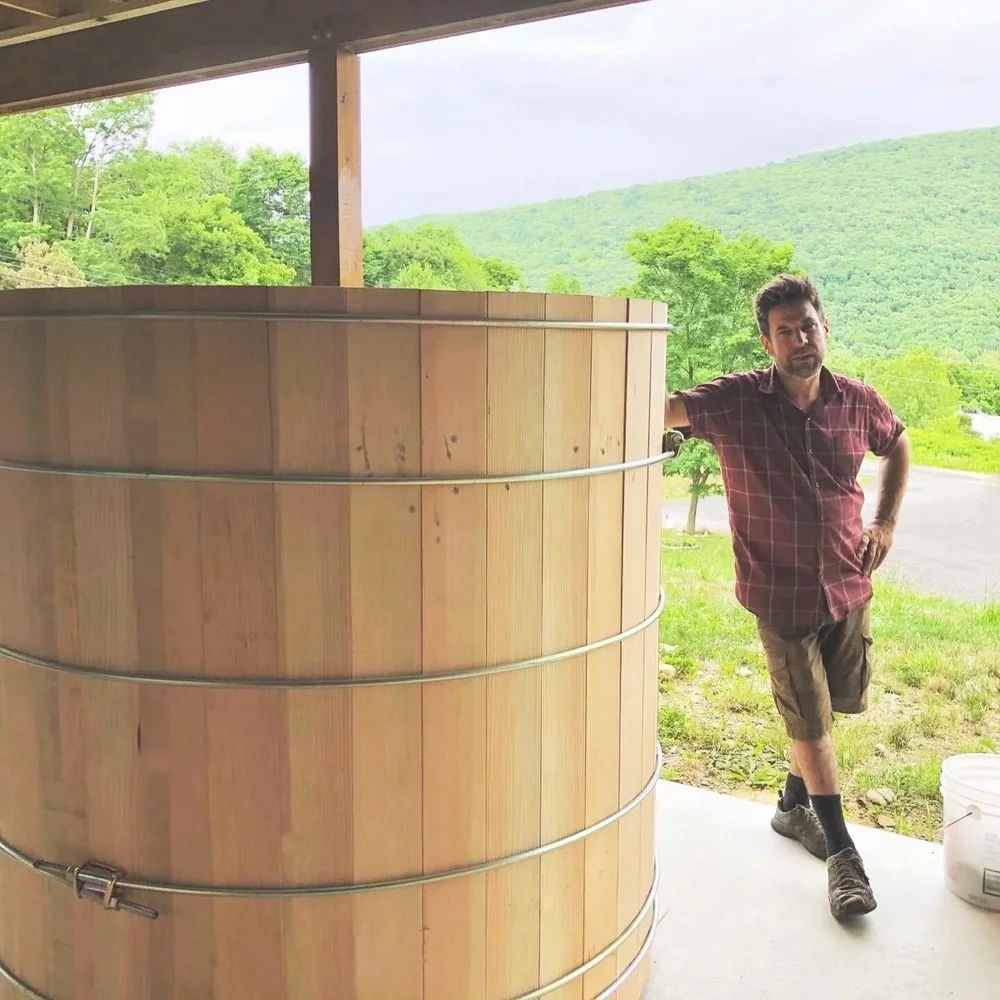
I build cold plunges from Western Red Cedar using traditional stave-and-band cooperage — the same joinery method used in wine barrels for centuries. No adhesives, no fiberglass, no acrylic shell. People sometimes ask why that matters for a cold plunge specifically. Here's the honest answer.
Thermal mass and temperature stability
Cedar's thermal conductivity is roughly 0.09 W/m·K — about 200 times lower than steel and significantly lower than acrylic (0.17–0.25 W/m·K). In practical terms, a cedar vessel loses heat to the ambient air more slowly than an acrylic one. On a cold January morning in Rhinebeck — I've done plenty of installs up there — that means your chiller cycles less frequently and your water temperature stays more consistent between sessions.
Antimicrobial properties
Western Red Cedar contains cedrol and cedrine, naturally occurring sesquiterpene compounds that inhibit bacterial and fungal growth. This matters in a cold plunge because cold water suppresses the effectiveness of chlorine — the same chemistry that makes pool sanitation harder in early spring. Cedar's natural antimicrobial surface doesn't replace proper water chemistry, but it provides a meaningful secondary defense. I've seen acrylic cold plunges develop biofilm problems within a season when owners under-maintained them. Cedar is more forgiving.
Freeze-thaw durability
Acrylic is a thermoplastic. It expands and contracts with temperature. In Hudson Valley winters — sustained cold below 20°F is normal in Dutchess and Columbia counties — repeated freeze-thaw cycling stresses acrylic shells at their seams and fittings. Cedar staves, held under compression by stainless bands, actually tighten as they absorb moisture. The cooperage joint gets stronger with use, not weaker.
If you're comparing vessel materials in detail, our cedar hot tubs page covers the construction method, and the installation and maintenance guide walks through what long-term ownership actually looks like in this climate.
Chiller sizing and temperature control in the Hudson Valley
A cold plunge without a chiller is an ice bath. That's a legitimate tool, but it's not a sustainable daily practice — hauling 40 lbs of ice every morning gets old fast, and the temperature is inconsistent. A properly sized chiller gives you repeatable, dialed-in immersion temperatures year-round.
Sizing a chiller for a Hudson Valley installation requires accounting for:
- Vessel volume: Most solo cold plunges run 80–150 gallons. A 1/3 HP chiller handles up to ~100 gallons adequately; larger vessels need 1/2 HP or more.
- Ambient temperature swing: In July and August near the Hudson River, ambient temps regularly hit 90°F with high humidity. Your chiller works harder in summer than winter — the opposite of what most people expect.
- Target temperature: Dropping a 100-gallon vessel from 75°F to 55°F takes roughly 8–12 hours on a 1/3 HP unit. Plan accordingly if you're starting fresh.
- Insulation: Foam insulation absorbs moisture over time, which degrades its R-value. Cedar's natural insulation is moisture-stable and doesn't degrade the same way.
I've seen undersized chillers burn out in their first Hudson Valley summer — the compressor runs continuously and overheats. Don't cheap out on BTU capacity. Our cold plunge chiller guide goes deep on sizing math, refrigerant types, and what to look for in a unit that will last more than two seasons.
If you're planning a full outdoor installation with decking, that affects airflow around the chiller unit — something worth thinking through early. See our custom decking page for how we integrate chiller placement into the overall build.
How to start safely and build a consistent protocol
The biggest mistake I see new cold plungers make is going too cold, too fast, too long. The cold shock response — that involuntary gasp and spike in heart rate — is the dangerous window. It peaks in the first 30–90 seconds and subsides as your body adapts. If you panic during that window, you're at risk of hyperventilation or, in rare cases, cardiac arrhythmia.
Here's a protocol I recommend to customers who are starting from zero:
- Week 1: 60°F water, 2 minutes. Focus on controlled nasal breathing. Don't fight the cold — breathe through it.
- Week 2: 58°F, 3 minutes. Notice that the gasp response is already shorter.
- Week 3: 55°F, 4–5 minutes. This is where most people find their sustainable working temperature.
- Week 4+: Adjust based on your goals. Recovery athletes often stay at 55–59°F. Those chasing BAT activation can work down to 50–52°F for 5–8 minutes.
A few non-negotiables:
- Never plunge alone if you're new. The cold shock response can cause disorientation.
- People with cardiovascular conditions, Raynaud's disease, or cold urticaria should consult a physician before starting. This is not a liability disclaimer — it's real physiology.
- Get out before you stop shivering. Paradoxical undressing and loss of coordination are signs of early hypothermia, not toughness.
- Rewarm passively (movement, dry clothes) rather than immediately jumping into a hot tub. The contrast can cause a rapid blood pressure drop.
If you want to talk through a setup that fits your space, goals, and budget, schedule a consultation — I'm happy to walk through the options without any pressure to buy.
