

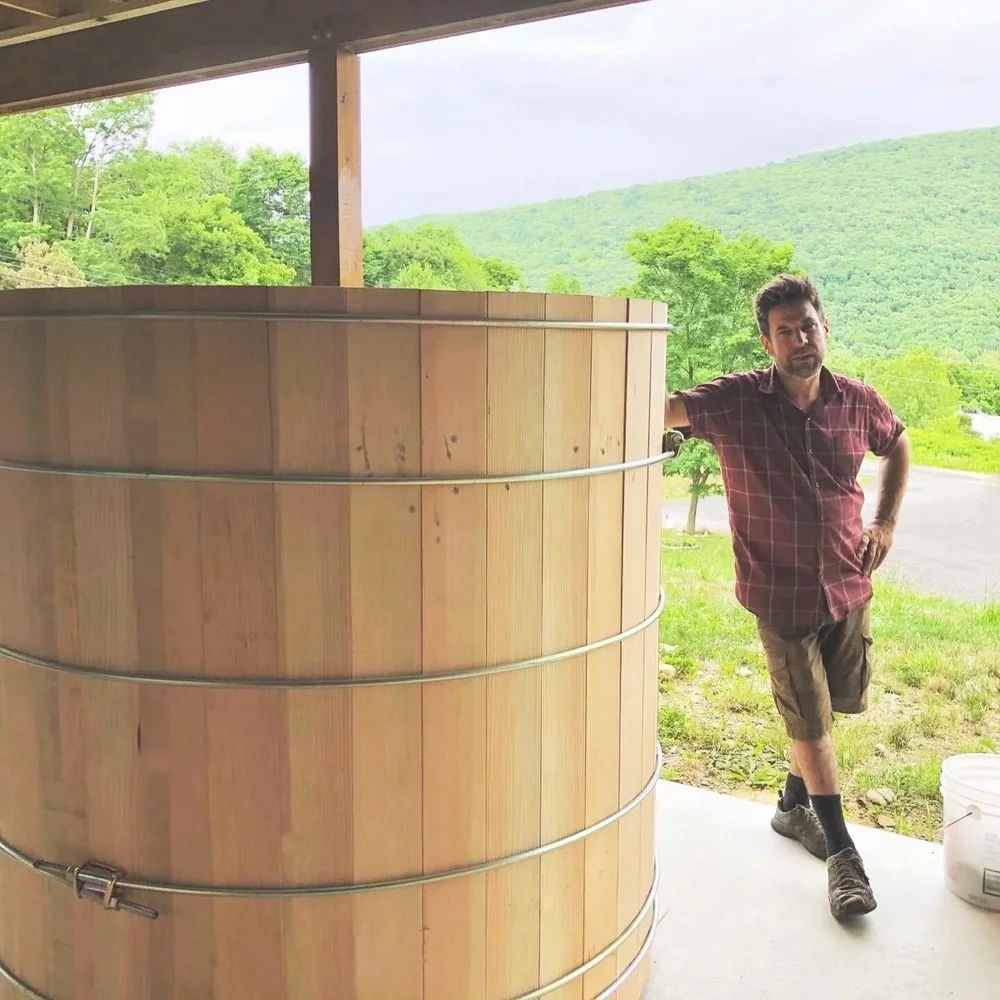
Why chiller sizing is the decision that matters most
I've pulled out undersized chillers from three different installs in Rhinebeck and Red Hook over the past two summers. Every one of them was a 1/5 HP unit dropped into a 250-gallon tub by someone who read a forum post and ordered the cheapest option. By July, the compressor was cycling non-stop and the water sat at 62°F — not cold enough to do much physiologically.
Here's the math that actually governs this decision. Water has a specific heat of 1 BTU per pound per degree Fahrenheit. A 200-gallon tub holds roughly 1,670 pounds of water. If your target is 50°F and ambient air is 90°F, you're fighting a 40°F differential plus continuous heat gain through the tub walls, the plumbing, and the pump motor itself. A cedar tub has a thermal conductivity around 0.08 W/m·K — far lower than acrylic (0.17) or stainless steel (16) — so cedar genuinely reduces that heat gain. But it doesn't eliminate it.
Use this as a starting framework:
| Tub Volume | Minimum Chiller HP | Approx. BTU/hr | Notes |
|---|---|---|---|
| 100–150 gal | 1/3 HP | 1,200–1,500 | Adequate for shaded installs; marginal in full sun |
| 150–250 gal | 1/2 HP | 1,700–2,200 | Most common residential size |
| 250–350 gal | 3/4–1 HP | 2,500–3,400 | Required for exposed or commercial use |
Always size to the next tier up if your tub sits in direct afternoon sun or you're targeting below 45°F. A chiller running at 70% capacity lasts years longer than one running at 100%.
For a full breakdown of what temperature ranges accomplish physiologically, see our Cold Plunge Temperature guide.
Plumbing layout: where the lines go and why it matters
A chiller is not a drop-in appliance. It needs a supply line pulling water from the tub, a filtration stage, and a return line pushing chilled water back in. Get the port locations wrong and you'll have a cold layer at the bottom and a warm layer at the top — which defeats the purpose and makes your temperature readings meaningless.
The correct port configuration
- Suction port: Place it at the mid-wall or bottom of the tub. Cold water is denser and sinks; you want to pull from where the warmest water accumulates, which is near the surface — but most chillers work best with a bottom suction to maintain prime.
- Return port: Position it at or near the waterline, angled slightly downward. This pushes chilled water across the surface where heat gain is highest and creates a gentle circulation pattern.
- Filter placement: Always inline before the chiller, never after. Debris in the chiller's heat exchanger is the second most common cause of premature failure I see, right behind undersizing.
Line sizing
Use 3/4-inch ID tubing minimum for tubs up to 200 gallons; step up to 1-inch for larger volumes. Undersized lines create back-pressure that reduces flow rate, which reduces heat exchange efficiency — your chiller works harder and cools less.
For cedar stave tubs, the through-wall fittings need a proper compression seal against the stave face. I use a double-gasket bulkhead fitting torqued to spec — not silicone, which fails with the seasonal wood movement you get in a Hudson Valley winter-to-summer swing. See our Installation & Maintenance page for fitting specs we use on every build.
Electrical requirements: the spec your electrician needs
This is where I see the most dangerous shortcuts. A 1/2 HP chiller draws roughly 7–9 amps at 240V on startup, with a locked-rotor amperage (LRA) spike of 2–3× that at startup. If you put that on a shared 15-amp circuit, you're going to trip breakers at best and melt wire insulation at worst.
Here are the non-negotiable electrical specs for a properly installed cold plunge chiller:
- Dedicated circuit: The chiller gets its own breaker. No sharing with the house, the deck lighting, or the hot tub.
- Breaker size: 20-amp minimum for 1/3–1/2 HP units; 30-amp for 3/4–1 HP.
- Voltage: Most chillers in this class run on 240V. Confirm before ordering — some smaller units are 120V, which limits your BTU ceiling.
- Wire gauge: 12 AWG for 20-amp circuits; 10 AWG for 30-amp. Use outdoor-rated, conduit-protected runs.
- GFCI protection: Required by NEC 680 for any equipment within 20 feet of a water feature. Non-negotiable.
- Disconnect: A lockable disconnect within sight of the unit, per NEC 430.
In Dutchess and Ulster counties, the building departments I've worked with consistently require a permit for new 240V circuits. Pull the permit. An unpermitted electrical install will complicate your homeowner's insurance claim if anything goes wrong.
If you're pairing a chiller with a cedar hot tub on the same deck, our cedar hot tubs are pre-plumbed for separate electrical feeds so the two systems don't share a load.
Year-round use in the Hudson Valley: summer heat load and winter freeze protection
The Hudson Valley is genuinely hard on outdoor water equipment. Summers in Columbia and Greene counties run humid and hot — 85–95°F ambient with dew points above 65°F is normal from late June through August. Winters drop below 20°F for sustained stretches, and the freeze-thaw shoulder seasons in March and November are the most mechanically stressful period for any outdoor plumbing.
Summer: your chiller's worst day
Size for your worst-case summer day, not your average. A chiller rated for 55°F target at 75°F ambient will struggle to hit 50°F when ambient climbs to 92°F. The refrigerant's condensing efficiency drops as ambient rises. If your tub is in full sun, add a shade structure or factor in an additional 15–20% BTU buffer when sizing. Custom decking with integrated pergola framing is something we design specifically to manage this — shade cuts solar heat gain on the tub surface by 40–60%.
Shoulder seasons: freeze-thaw stress
Acrylic shells crack under freeze-thaw cycling — I've seen it happen to a neighbor's acrylic plunge in Germantown after one hard freeze with water left standing in the lines. Cedar stave construction moves with temperature changes rather than cracking, but your chiller's refrigerant lines, pump housing, and heat exchanger are still vulnerable. When temps drop below 35°F:
- Drain and blow out the chiller's water-side lines with compressed air if you're winterizing.
- If running year-round, insulate the chiller's water lines with closed-cell foam pipe insulation — not fiberglass batting, which absorbs moisture and loses R-value within one season in our humidity.
- Keep the chiller's compressor compartment clear of snow accumulation, which blocks condenser airflow.
Winter: free cooling
Below about 40°F ambient, you don't need the chiller at all. The tub will self-regulate near ambient temperature. Shut the chiller off, leave the circulation pump running on a timer to prevent stagnation, and let the Hudson Valley do the work. This is one of the underappreciated advantages of an outdoor plunge — roughly five months of the year, your operating cost drops to near zero.
Our full Cold Plunge guide covers seasonal protocols in more detail.
Water chemistry with a chiller-equipped cedar plunge
Cold water slows chemical reactions — that's the point — but it also slows sanitizer demand, which leads some people to under-treat their plunge. Don't. A chiller recirculates water through a heat exchanger that's warm on the refrigerant side, which is a biofilm risk if sanitizer levels drop.
The chemistry targets I use on every cedar plunge build:
- Free chlorine: 1–3 ppm. At 50°F, chlorine degrades slowly, so you won't need to dose as frequently as a hot tub, but test twice weekly.
- pH: 7.2–7.6. Cedar is slightly acidic; new tubs may pull pH down in the first few weeks. Test more frequently during break-in.
- Total alkalinity: 80–120 ppm. This buffers pH swings.
- Cyanuric acid: 20–40 ppm if the tub is in direct sun and you're using stabilized chlorine. Omit if the tub is shaded — CYA reduces chlorine efficacy at low temperatures.
Cedar's natural cedrol and thujopsene compounds do provide some antimicrobial action against gram-positive bacteria — this is documented in wood science literature, not marketing copy. But they are not a substitute for active sanitizer. Think of them as a secondary defense, not a primary one.
One practical note: chillers with titanium heat exchangers are chlorine-compatible. Copper heat exchangers are not — chlorine corrodes copper rapidly, and you'll be replacing the exchanger within a season. Confirm the heat exchanger material before you buy.
For more on the health side of regular cold immersion, see our Cold Plunge Benefits article.
Is a chiller the right choice for your setup?
A chiller is not always the answer. Here's an honest breakdown of when it makes sense and when it doesn't.
When a chiller is worth it
- You want consistent temperature year-round without buying and hauling ice.
- You're using the plunge more than three times per week — at that frequency, ice costs add up fast and the convenience math flips decisively toward a chiller.
- Your tub is in a location where ice delivery is impractical (second-story deck, tight access, etc.).
- You're targeting below 50°F reliably — ice in a 250-gallon tub on a 90°F day is a losing battle.
When ice or ambient cooling may be sufficient
- You plunge seasonally, primarily in fall and winter, when Hudson Valley ambient temps do the work for free.
- Your budget is constrained — a quality 1/2 HP chiller runs $1,500–$3,500 installed (Hudson Valley, 2026), which is a real number to weigh against use frequency.
- You have easy ice access and plunge fewer than twice a week.
If you're on the fence, I'm happy to walk through the numbers for your specific tub size and use pattern. Schedule a consultation and we'll size it correctly before you spend a dollar on equipment.
You can also read more about how we approach builds to understand what goes into a cedar plunge that's designed to work with a chiller from the ground up — not retrofitted after the fact.
