

The temperature spectrum: what each zone actually does
Cold water pulls heat from your body roughly 25 times faster than cold air at the same temperature. That's the physics that makes cold plunging work — and it's why the number on your thermometer matters more than how cold it feels when you step outside on a January morning in Rhinebeck.
Here's how I break the spectrum down for customers:
| Temperature Zone | Range | Primary Effect | Best For |
|---|---|---|---|
| Cool | 60–68°F | Mild vasoconstriction, alertness | First-timers, hot-weather cool-down |
| Cold | 50–59°F | Norepinephrine rise, muscle recovery | Regular practitioners, post-workout |
| Very Cold | 45–49°F | Strong cold-shock response, dopamine spike | Adapted athletes, mental resilience training |
| Extreme | 39–44°F | Maximum sympathetic activation | Experienced practitioners with specific goals |
Below 39°F you're approaching ice-water territory. At that point you're fighting the thermometer more than training your nervous system, and the risk of hyperventilation and cold incapacitation climbs steeply. I don't build chillers that go below 39°F, and I'd push back on any customer who asked me to.
For a deeper look at the full range of physiological effects, see our Cold Plunge Benefits guide.
50°F vs. 39°F: the real-world tradeoff
This is the question I get most often at consultations. Someone has watched a video of an athlete sitting in near-freezing water and wants to know if they need to go that cold to get results. The honest answer is: almost certainly not.
The case for 50°F
Research on norepinephrine release shows a significant spike beginning around 57°F and a substantial increase at 50°F. The marginal gain from dropping another 10 degrees is real but modest — and the cost is a much harder session that beginners often cut short, which defeats the purpose entirely. At 50°F, most people can hold a calm, controlled breath pattern for 3–5 minutes once they've adapted over a few weeks. That's enough time to drive the adaptation you're after.
The case for 39°F
If your goal is maximum cold-shock protein response, brown adipose tissue activation, or you're an athlete with a specific recovery window (say, 45 minutes post-competition), then colder water shortens the required immersion time. One minute at 39°F delivers a comparable thermal load to roughly 2.5–3 minutes at 50°F. For people with tight schedules or very high adaptation levels, that math is relevant.
The practical ceiling: Most Hudson Valley customers I've set up end up dialing their chiller to 50–54°F and staying 3–4 minutes. That's the sweet spot where the protocol is sustainable five days a week without dreading it.
Want to understand what equipment holds these temperatures reliably? See our Cold Plunge Chiller breakdown.
Stay-time by adaptation level: a practical framework
Temperature and duration are two variables in the same equation. Dialing one up means you can dial the other down. Here's the framework I walk new customers through:
- Week 1–2 (Beginner): 60°F water, 1–2 minutes. Focus entirely on breath control — slow exhale through the mouth, don't fight the gasp reflex, just outlast it. The goal is neurological familiarity, not thermal load.
- Week 3–4 (Early Adaptation): Drop to 55°F, extend to 2–3 minutes. You should be able to hold a conversation by the 90-second mark. If you can't, the water is too cold for this stage.
- Month 2 (Intermediate): 50–53°F, 3–5 minutes. This is where most people plateau productively. Mood, sleep, and recovery benefits are well-established at this combination.
- Month 3+ (Advanced): 45–50°F, 4–6 minutes, or 39–44°F, 1–3 minutes. Only move here if the previous stage feels genuinely comfortable — not just tolerable.
A note on Hudson Valley winters: I've had customers in Columbia County tell me they skip the chiller in January because their well water comes out at 38°F. That's fine for a 60-second dunk, but it's not a controlled protocol. A properly sized chiller holds ±1°F all year. Passive methods swing 8–12°F in a single session, which makes adaptation tracking meaningless.
The gasp reflex peaks in the first 30 seconds regardless of temperature. If you can get through that window with a controlled exhale, you've already done the hardest part of the session.
Contrast bathing: pairing your cold plunge with a hot tub
Contrast bathing — alternating between hot and cold immersion — is one of the most underused protocols in residential settings. Scandinavian and Finnish traditions have used it for centuries, and the physiology holds up: the rapid vasoconstriction-to-vasodilation cycle flushes metabolic waste from muscle tissue more effectively than either modality alone.
A basic contrast protocol
- Hot tub: 102–104°F for 10–15 minutes
- Cold plunge: 50–55°F for 2–3 minutes
- Repeat: 2–3 cycles
- End cold if the goal is recovery or alertness; end hot if the goal is relaxation or sleep
The Hudson Valley shoulder seasons — March through May, September through November — are ideal for contrast bathing. Ambient temperatures are already stressing your thermoregulatory system, and the contrast between a 103°F cedar hot tub and a 52°F plunge is visceral in a way that's hard to replicate in summer.
Our Cedar Hot Tubs are built to the same stave-and-band cooperage standard as our cold plunges, so the thermal mass of the wood works in your favor on both ends of the contrast cycle. Cedar holds heat differently than acrylic — the wood itself doesn't leach cold or heat the way a polymer shell does.
If you're planning a combined installation, our Custom Decking team can position both vessels for a single-step transition, which matters more than it sounds when you're barefoot in October.
What a cedar vessel does to the felt experience at any temperature
This is where I have to be careful not to oversell, so let me be precise about what the wood actually does and doesn't do.
What cedar does
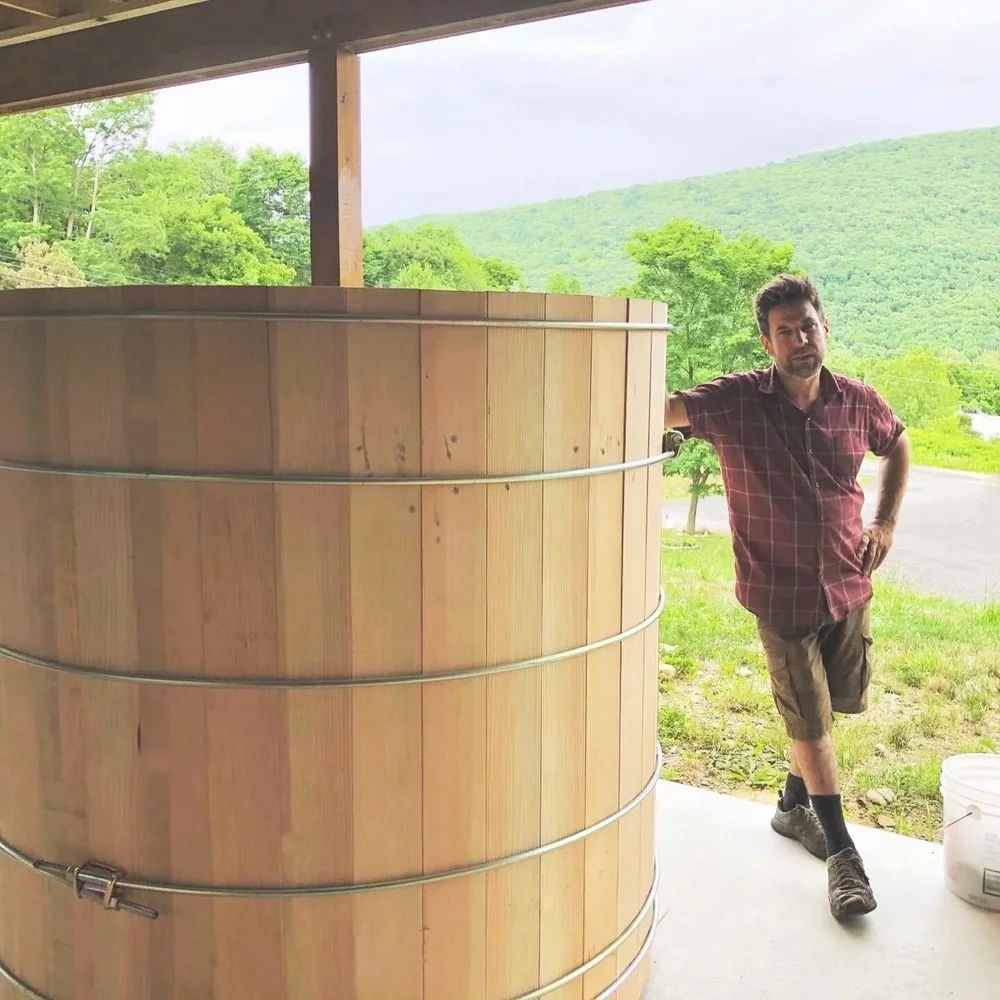
Western Red Cedar has a thermal conductivity of roughly 0.08 W/m·K. Acrylic runs about 0.19 W/m·K — more than twice as conductive. In practical terms, when you lower yourself into a cedar cold plunge, the stave walls don't feel like a block of ice against your skin the way a stainless steel or acrylic shell does. The initial contact shock is measurably lower. I've had customers who struggled to get past 30 seconds in an acrylic tub adapt to a 3-minute protocol in a cedar vessel within two weeks — not because the water was warmer, but because the entry experience was less aversive.
Cedar also contains natural cedrol and cedrine compounds that leach very slowly into the water. There's emerging research on cedrol's mild anxiolytic properties when inhaled; whether trace amounts in water have a measurable effect is an open question, but the aromatic environment of a cedar plunge is genuinely different from a plastic one.
What cedar doesn't do
Cedar is not an insulator in the sense of a foam-jacketed stainless vessel. It will lose temperature over time without a chiller. In a Hudson Valley July, an unchilled cedar plunge will climb from 50°F to 65°F in a few hours of direct sun. That's why I always pair cedar builds with a properly sized chiller — the wood handles the felt experience, the chiller handles the physics.
For the full picture on our construction approach, visit our Cold Plunge pillar guide.
Chiller sizing and temperature stability in the Hudson Valley climate
Temperature stability is a chiller problem, not a wood problem. Here's what I look at when sizing a chiller for a Hudson Valley installation:
- Vessel volume: Most residential cold plunges run 150–300 gallons. A 1/3 HP chiller handles up to ~200 gallons adequately in ambient temps below 85°F. Above that, you want 1/2 HP or a dual-circuit unit.
- Ambient air temperature: A chiller working against 95°F July air in Tivoli is working harder than the same unit in April. I size for the worst-case summer day, not the average.
- Sun exposure: A plunge in direct afternoon sun on a south-facing deck in Germantown can absorb 500–800 BTUs per hour from solar gain alone. Shade or a cover matters.
- Target temperature: Holding 39°F in August requires roughly 30–40% more chiller capacity than holding 50°F. If you want extreme cold year-round, budget for a larger unit.
I've seen customers buy undersized chillers online and then wonder why their 39°F target drifts to 52°F by noon in August. The chiller spec sheet will list BTU output at a specific ambient temperature — usually 70°F. That number is optimistic for a Hudson Valley summer. Ask for the BTU rating at 90°F ambient before you buy.
See our detailed Cold Plunge Chiller page for specific unit recommendations and sizing math.
Getting the setup right from the start
Cold plunge temperature is only one variable in a system that includes vessel material, chiller capacity, placement, water chemistry, and your own adaptation protocol. Get the temperature right but ignore water chemistry, and you'll be fighting algae in a cedar tub by August — I've seen it happen twice in Greene County installations where customers skipped the bromine protocol.
A few practical points before you commit to a build:
- Water chemistry: Cold water (below 55°F) slows sanitizer activity. You need to test more frequently, not less. Bromine is more stable than chlorine at low temperatures.
- Cover discipline: A well-fitted cover reduces solar gain, keeps debris out, and cuts chiller runtime by 20–30%. This is not optional in a Hudson Valley summer.
- Placement: North or east-facing positions reduce afternoon solar load. If you're pairing with a hot tub, think about the transition path — wet feet on a frosty deck in November is a real hazard.
- Maintenance schedule: Cedar staves need periodic inspection for band tension, especially after the first freeze-thaw cycle. This is standard cooperage maintenance, not a defect.
Our Installation & Maintenance page covers the full first-year checklist. And if you want to talk through a specific setup for your property — lot size, sun exposure, goals — schedule a consultation and we'll work through the numbers together.
