

What a cedar hot tub actually is — and what it isn't
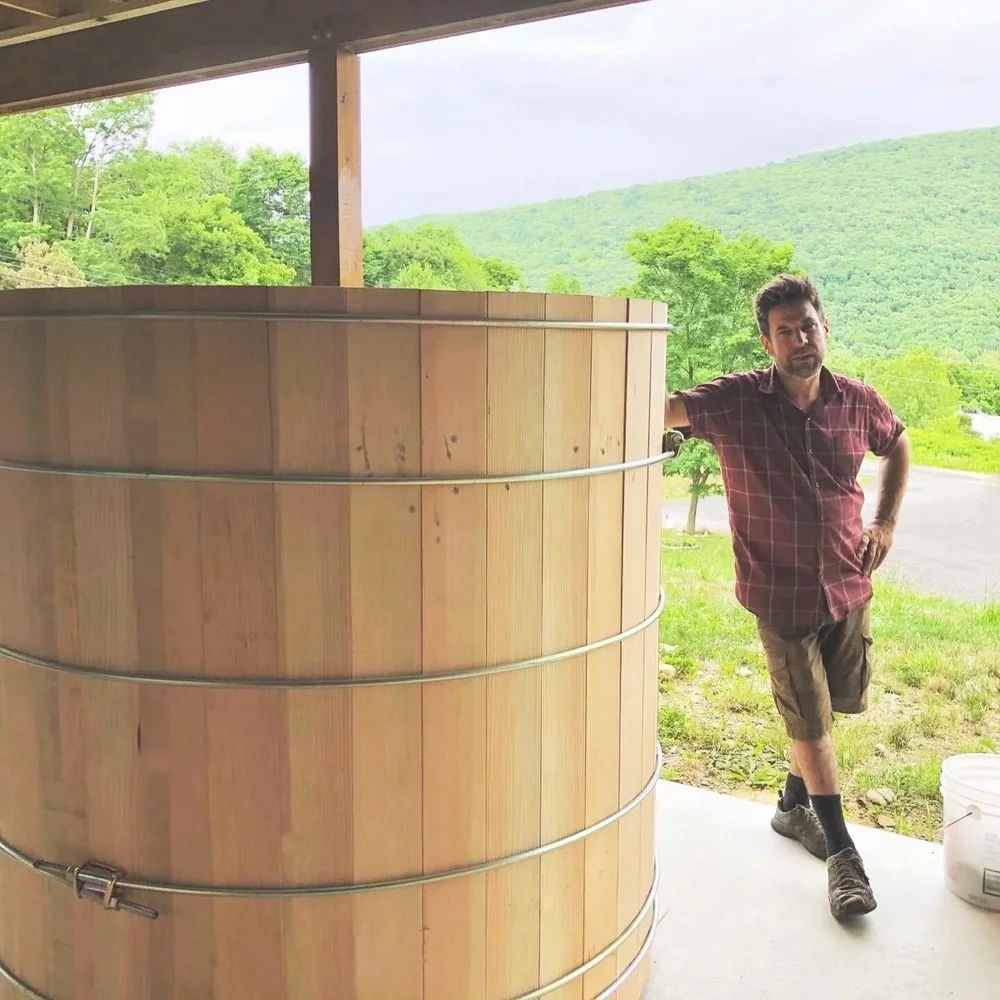
A cedar hot tub is a cooperage vessel: vertical wooden staves, machined to a precise taper, fitted edge-to-edge around a circular floor, then compressed by metal bands. There's no inner liner, no acrylic shell, no structural adhesive. The wood itself is the vessel. When you fill it, the staves swell slightly and the joints become watertight. That's the same physics a barrel maker has relied on for 2,000 years.
What it isn't: a rectangular wooden surround around a plastic shell. You'll see those sold as "wood hot tubs" online — the wood is purely decorative cabinetry. A true cedar tub holds water with wood alone. That distinction matters because it determines how the tub ages, how it's repaired, and how it interacts with your water chemistry.
It also isn't a Japanese soaking tub (ofuro), though the two share a philosophy of unfinished wood and deliberate simplicity. Ofuro are typically smaller, rectangular or oval, and built from hinoki cypress rather than cedar. I'll note the overlap where it's relevant, but they're different traditions.
Species matter: why Western Red Cedar, and what comes second
I've worked with half a dozen wood species over 20 years. Western Red Cedar (Thuja plicata) is the one I keep coming back to, and not for marketing reasons. Here's the chemistry: cedar contains cedrol, thujopsene, and cedrine — volatile organic compounds in the heartwood that inhibit bacteria and fungi. That's why old-growth cedar fence posts rot last. In a hot tub context, those same compounds give the wood a meaningful head start against biofilm formation in the joint gaps between staves.
Cedar is also dimensionally stable under moisture cycling. It swells and shrinks less per moisture-content percentage point than pine, oak, or spruce. In a tub that's filled Monday and drained for a week in July, that stability is the difference between joints that stay tight and joints that gap and weep.
| Species | Decay resistance | Dimensional stability | Typical use |
|---|---|---|---|
| Western Red Cedar | Excellent (heartwood) | Very good | Staves, floor, bench |
| Alaskan Yellow Cedar | Excellent | Good | Staves (harder to source) |
| Redwood (old-growth) | Excellent | Good | Staves — now rare, expensive |
| Douglas Fir | Moderate | Poor | Avoid for staves |
| Pine / Spruce | Poor | Poor | Decorative surrounds only |
One real-world note: I inspected a tub in Catskill that had been built with Douglas Fir staves to cut costs. At year four, three staves had cupped badly enough to require replacement. The bands were torqued down to compensate, which overstressed the floor dado. Full rebuild at year six. The upfront savings evaporated fast.
Cooperage construction: staves, floor, bands, and the joints that hold water
The stave is the fundamental unit. Each one is milled with a slight radial taper — wider on the outside face, narrower on the inside — so that when you arrange dozens of them in a circle, the inside faces form a smooth, continuous cylinder. A typical 6-foot diameter tub uses 30 to 36 staves, each 2 inches thick. The precision of that taper is everything. A tolerance error of even half a degree compounded across 36 staves means the last stave won't close the circle.
The floor sits in a dado — a groove routed into the bottom of every stave — typically 1.5 to 2 inches up from the bottom edge. The floor itself is built from shorter boards, edge-glued and doweled, because a solid slab that wide would move too much. The dado allows the floor to float slightly as moisture content changes.
Bands compress the assembly. I use stainless-steel T-316 bands for anything near salt-water chemistry or coastal humidity. For standard freshwater tubs, hot-dipped galvanized bands work well and are easier to tension in the field. A new tub typically gets three to five bands spaced vertically. Band tension is set by feel and experience — too loose and the tub weeps; too tight and you risk splitting staves at the dado. I re-tension every tub at the 30-day mark after first fill, and again at six months.
For a deeper look at how this compares to a plastic shell in real-world conditions, see our Cedar vs Acrylic breakdown.
Sizing your cedar tub: diameter, depth, and water volume math
Most residential cedar tubs run 5 to 7 feet in interior diameter and 36 to 42 inches deep. Here's how to think about capacity:
- 5 ft diameter, 36 in deep: ~550 gallons, 2–4 soakers
- 6 ft diameter, 42 in deep: ~900 gallons, 4–6 soakers
- 7 ft diameter, 42 in deep: ~1,200 gallons, 6–8 soakers
Those gallon numbers drive your heater selection. To raise 900 gallons by 1°F takes roughly 7,500 BTUs. If you're starting from a 55°F well or municipal supply and want to reach 104°F — a 49°F rise — you need about 367,500 BTUs of total work. A properly sized 120,000 BTU propane or natural-gas heater gets you there in 3 to 4 hours. An undersized 55,000 BTU unit takes 7+ hours, and that prolonged heating cycle is harder on the wood joints than a fast, efficient heat-up.
The same math applies if you're running a cold plunge. A BTU-adequate chiller cycling the water down to 50°F and maintaining it is far less stressful on the staves than a unit that hunts up and down 10 degrees trying to keep up. I've seen joint gaps open up on tubs paired with undersized chillers — thermal cycling, not age, was the culprit.
Curious about wood-fired heating as an alternative? It's a legitimate option for properties without gas, but the BTU math still applies — you just manage it with firewood instead of a thermostat.
Water chemistry in a cedar tub: the numbers that protect both you and the wood
I'll be direct: water chemistry is where most cedar tub failures actually start. Not the wood. Not the bands. The water.
Cedar's natural antimicrobial compounds slow biofilm growth, but they don't replace sanitation. You still need to maintain:
- pH: 7.2–7.6. Below 7.0, the water becomes acidic enough to leach tannins aggressively from the wood and corrode metal fittings. Above 7.8, chlorine (or bromine) loses most of its sanitizing effectiveness and scale begins depositing on stave surfaces.
- Total Alkalinity: 80–120 ppm. This is your pH buffer. Without it, pH swings wildly with every rainstorm or bather load.
- Sanitizer: 1–3 ppm free chlorine (or 2–4 ppm bromine). Bromine is gentler on wood and more stable at the higher temps cedar tubs often run (102–104°F).
- Calcium Hardness: 150–200 ppm. Soft water is aggressive toward wood fibers. Hard water above 300 ppm scales the stave surfaces and blocks the natural swelling that keeps joints tight.
One thing I test for that most guides skip: tannin content. A new cedar tub will leach significant tannins for the first 3–6 weeks, turning the water tea-colored and artificially lowering the apparent pH reading. Test with a tannin-compensating strip or account for it when interpreting your pH meter. Don't chase that false low reading by dumping in pH-up — you'll overshoot and spend a week correcting.
Our full Maintenance Guide covers seasonal winterization, mid-season chemistry adjustments, and what to do when a tub sits empty for more than 2 weeks.
Hudson Valley climate and what it means for your cedar tub
Dutchess, Ulster, Columbia, and Greene counties are not the Pacific Northwest. We get real winters — sustained stretches below 15°F, wind chill into the negatives, and the freeze-thaw shoulder seasons in March and November that are harder on outdoor structures than the deep cold itself.
Here's what that means in practice:
- A properly maintained, filled cedar tub handles Hudson Valley winters better than you'd expect. The mass of water holds heat. A good insulating cover and a functioning heater can keep the tub at 102°F through a January cold snap with manageable energy cost.
- The danger is a tub that's partially drained or left at 40°F with no heater running. Water freezing in the floor dado cracks staves. I've repaired that failure on three tubs — all from owners who tried to "save energy" by letting the temp drop to near-freezing rather than running the heater or fully draining.
- If you fully drain for winter, do it right. Remove all water from the plumbing lines, loosen band tension by one full turn per band to allow stave movement as the wood dries, and cover the open tub to keep debris and ice out of the floor dado.
- Acrylic shells crack in freeze-thaw cycles if not properly winterized — that's a structural failure, not a cosmetic one. Cedar moves and recovers. See our Cedar vs Acrylic comparison for the full breakdown.
On a job in Rhinebeck last winter, I re-tensioned a 7-year-old tub that had been through 7 Hudson Valley winters with zero stave replacement. The owner kept pH in range, never let it drop below 60°F, and re-tensioned bands every spring. That tub looked like it was 2 years old.
Handcrafted vs. factory-built cedar tubs: what the difference costs you
Factory-built cedar tubs exist. They're milled to spec overseas or in large domestic facilities, flat-packed or pre-assembled, and they work — to a point. Here's where the gap shows up:
- Stave grade. A handcrafted tub uses select, tight-grained heartwood with minimal sapwood exposure. Factory units often use mixed grades; the sapwood sections lack the natural decay resistance of heartwood and are the first to fail.
- Taper precision. Hand-coopering allows the craftsman to test-fit and adjust individual staves before final assembly. A factory tub assembled to dimensional tolerances on a jig can have compounding fit errors that show up as weeping joints in year two.
- Local accountability. When something fails — a stave splits, a band corrodes, a dado cracks — you need someone who can come out, diagnose, and fix it with matching wood. A factory tub shipped from a distribution center doesn't come with that.
- Repairability. A cedar hot tub is one of the few outdoor installations that is truly field-repairable. Individual staves can be replaced without demolishing the whole tub. That's a 30-year asset, not a 10-year appliance.
I won't pretend handcrafted work is cheap. It isn't. See our Cedar Hot Tub Cost page for honest numbers by size and configuration. But if you're comparing total cost of ownership over 20 years, the math often closes the gap.
Ready to talk specifics for your site? Schedule a consultation and I'll walk the property with you — drainage, electrical, access, sun exposure, all of it.
What to look for (and ask) before you buy any cedar hot tub
Whether you're buying from me or anyone else, here are the questions that separate a 30-year tub from a 7-year headache:
- What species is the heartwood? Ask for the mill spec sheet, not a brand name. "Cedar" can legally mean eastern red cedar, northern white cedar, or Atlantic white cedar — none of which perform like Western Red Cedar in water immersion.
- What band material? Galvanized is fine for freshwater. Stainless T-316 if you're running salt systems or in a coastal-humidity environment. Avoid painted mild steel.
- What's the floor dado depth? It should be at least 1 inch deep. Shallow dados allow the floor to rock under bather load, which opens the joint over time.
- Is there any finish or sealant inside? There shouldn't be on the water-contact surfaces of a properly built cedar tub. Sealants trap moisture behind the wood surface and accelerate rot. The exterior can be oiled; the interior should be bare wood.
- Who re-tensions the bands at 30 days and 6 months? If no one does, that's a problem. Band tension is a maintenance item, not a one-time setup.
You can also browse our full line of cedar hot tubs to see how we specify each of these details by model, or read more about the broader wood hot tub category if you're still comparing options.
