

What is a Japanese soaking tub — and what is an ofuro?
The word ofuro (お風呂) literally means "bath," but in practice it refers to a specific vessel and a specific ritual. The tub is deep — typically 24–28 inches of interior depth — and compact in footprint, often 36–48 inches across. You sit on a small internal bench or simply crouch, and the water reaches your shoulders. That depth is the whole point: hydrostatic pressure on the chest and abdomen slows the heart rate and shifts the nervous system toward parasympathetic dominance faster than a shallow soak ever will.
Traditional ofuro are built from hinoki cypress (Chamaecyparis obtusa) or sugi (Japanese cedar, Cryptomeria japonica). Both species carry aromatic terpene compounds — hinokitiol in hinoki, cryptomeridiol in sugi — that suppress mold and bacteria in the wet wood grain. That is not marketing language; it is the same biochemical mechanism that makes our Western Red Cedar (Thuja plicata) resistant to rot through its cedrol and cedrine content. Different species, same evolutionary strategy.
The ritual matters as much as the vessel. In a traditional Japanese household, you wash completely before you enter the ofuro. The tub water stays clean enough for the whole family to use sequentially. That discipline — body clean before immersion — is something every hot tub owner should adopt, because it directly reduces the bather load your sanitizer has to handle.
How cooperage cedar tubs learned from the ofuro
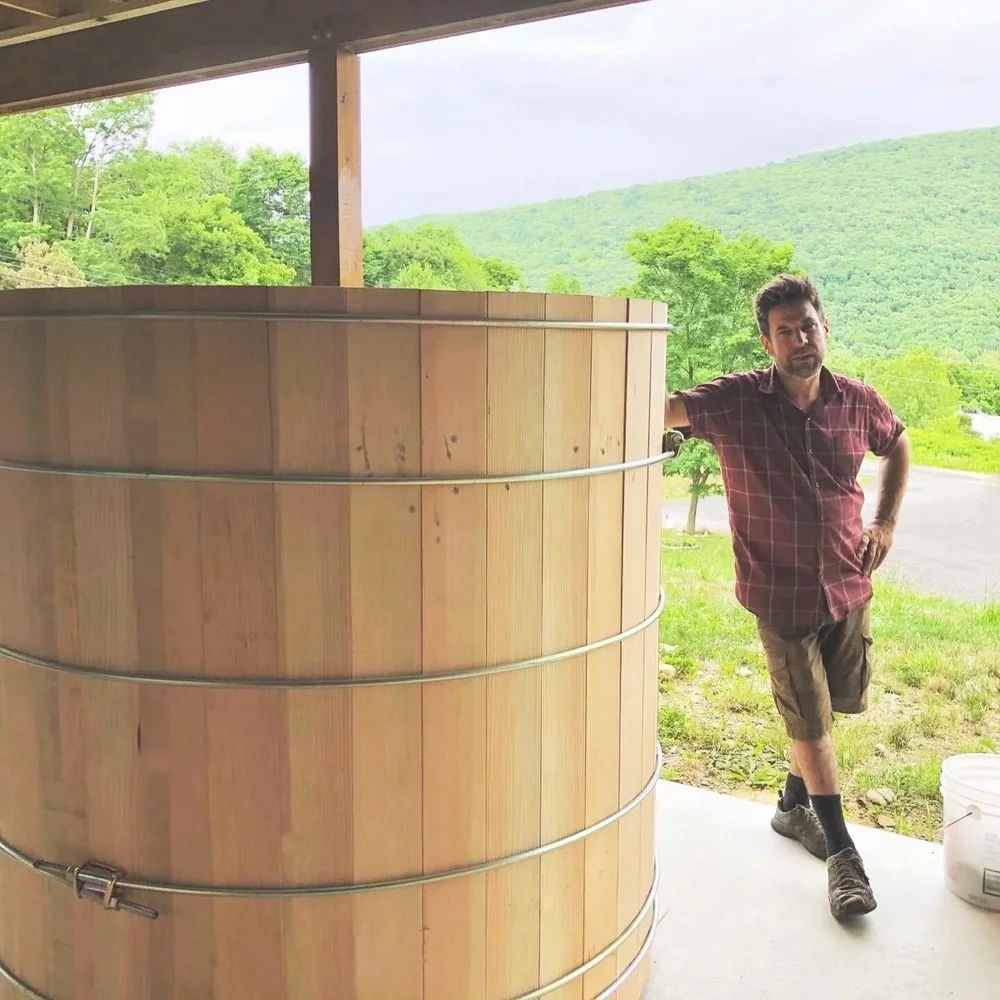
When I started building cedar tubs in the Hudson Valley, I spent a lot of time studying how Japanese craftsmen solved the same core problem: how do you make a watertight vessel from wood without glue, without fiberglass, and without metal fasteners touching the water? The answer in both traditions is cooperage geometry — staves cut with a slight bevel so that when they are pulled together by galvanized or stainless bands, the geometry itself creates the seal. No caulk. No adhesive. The wood swells against itself.
The differences are in scale and environment. An indoor ofuro holds 60–90 gallons. Our outdoor cooperage tubs run 250–500 gallons. An ofuro sits in a heated bathroom; our tubs sit in a Greene County backyard at 12°F in January. That changes the engineering considerably — wall thickness, band spacing, the grade of cedar, and how you insulate the floor all have to account for freeze-thaw cycling that an indoor Japanese tub never sees.
I've pulled apart failed acrylic shells and failed wood tubs alike. The acrylic fails at the shell-to-skirt bond when freeze-thaw stress works the joint over several seasons. The wood tub fails when the staves dry out unevenly — usually because someone drained it for more than two weeks in winter without following a proper winterization protocol. Both failure modes are preventable. See our maintenance guide for the exact steps.
What the ofuro tradition got right — and what I carry forward — is the respect for wood movement. You do not fight it. You design around it.
Japanese soaking tub vs. cooperage cedar tub: an honest comparison
These two formats solve different problems. Here is a direct comparison so you can make a clear decision:
| Factor | Japanese Ofuro | Cooperage Cedar Tub |
|---|---|---|
| Typical volume | 60–90 gallons | 250–500 gallons |
| Depth | 24–28 in (shoulder-deep seated) | 36–42 in (standing entry, seated soak) |
| Typical location | Indoor bathroom | Outdoor deck or grade |
| Heating method | Electric inline heater or gas | Electric, gas, or wood-fired |
| Heat-up time (cold start) | 20–40 min | 2–6 hours (wood fire) / 1–3 hours (electric) |
| Occupancy | 1–2 people | 2–6 people |
| Climate suitability | Indoor; not freeze-rated | Year-round outdoor, rated for sub-zero |
| Wood species | Hinoki cypress or sugi | Western Red Cedar |
| Construction | Stave-and-band cooperage | Stave-and-band cooperage |
| Maintenance complexity | Low (small volume, fresh fill) | Moderate (ongoing water chemistry) |
Notice that the construction method is identical. The divergence is in scale, climate rating, and intended use. If you want a private indoor ritual for one or two people and you have the bathroom space, an ofuro is a legitimate choice. If you want to soak outdoors year-round in Dutchess or Ulster County — possibly with a partner or guests — a full cooperage cedar tub is the right tool. You can read more about how cedar compares to acrylic shells in our cedar vs. acrylic breakdown.
The ofuro ritual — and why it makes any hot tub work better
The Japanese bathing sequence is: shower or wash basin first, ofuro second. This is not optional etiquette in a traditional household — it is the reason the water stays usable. When you enter a clean body, you are not introducing body oils, deodorant residue, sunscreen, or cosmetics into the water. Those compounds are what drive chlorine demand up and what form chloramines — the compounds that cause the "chemical smell" people wrongly attribute to too much chlorine. It is almost always too little chlorine relative to the bather load.
I tell every customer the same thing at installation: rinse off before you get in. It sounds obvious. Almost nobody does it consistently until they see their water clarity hold for three weeks instead of one.
For a small ofuro with 70 gallons of water, the math is unforgiving. One person with unwashed skin can shift the pH and consume free chlorine fast enough to make the water unsafe within a single soak. For a 400-gallon cooperage tub, you have more buffer — but the principle holds. Adopt the ofuro ritual and your water chemistry maintenance becomes dramatically simpler.
Temperature discipline matters too. The traditional ofuro runs 104–108°F. That range is not arbitrary — it is where the cardiovascular response (vasodilation, heart rate drop, core temperature rise) happens efficiently without the risk of heat exhaustion that comes above 110°F. Keep your soak to 15–20 minutes at that temperature. Get out, cool down, re-enter if you want. That is the protocol, and it is physiologically sound.
Are Japanese soaking tubs worth it — and which format fits Hudson Valley?
Worth it compared to what? That is always the right question. Compared to a standard 14-inch-deep American bathtub, an ofuro is worth every dollar — the immersion depth alone changes the experience completely. Compared to a full outdoor cooperage cedar tub, the calculus depends on your situation.
Here is what I have seen in 20 years of installations across Dutchess, Ulster, Columbia, and Greene counties:
- Buyers who want a private, meditative solo soak and have a bathroom they can retrofit often do well with an indoor ofuro. The smaller water volume means faster heat-up and lower ongoing energy cost.
- Buyers who want outdoor year-round use — including the specific pleasure of soaking at 104°F while it is snowing — need a cooperage cedar tub built for freeze-thaw conditions. An indoor ofuro is not rated for that environment.
- Buyers who want social soaking — two to six people — need the volume and seating geometry of a full outdoor tub. An ofuro is a one-person vessel.
- Buyers on a tighter budget should know that a quality hinoki ofuro and a quality cooperage cedar tub both represent real money. Neither is a budget purchase. See our cedar hot tub cost guide for current Hudson Valley pricing ranges.
On a job in Rhinebeck last spring, a customer asked me to help them choose between an indoor ofuro and an outdoor cedar tub. They had a small bathroom and a large deck. We put the cedar tub on the deck. They use it four seasons. That was the right call for their situation — but it would not be the right call for everyone.
If you are still deciding, schedule a consultation and we can walk through your space, your climate exposure, and your actual use patterns before you commit to either format. We also have a full overview of cedar tub options at our cedar hot tubs guide.
Wood species: hinoki, sugi, and Western Red Cedar compared
People ask me regularly whether we can build in hinoki. The honest answer is: hinoki is a genuinely beautiful wood with exceptional aromatic properties, but it is not commercially available in the stave grades and volumes we need for outdoor cooperage tubs in the United States. What you find is either thin decorative planking or small-format indoor tub blanks. For a 400-gallon outdoor vessel that has to survive a Hudson Valley winter, you need Western Red Cedar — specifically old-growth or tight-grain second-growth stock with 20+ rings per inch.
Here is how the three species compare on the properties that matter for a soaking vessel:
- Hinoki cypress: Exceptional rot resistance, fine grain, releases hinokitiol (antimicrobial terpene). Ideal for indoor ofuro. Expensive and scarce in North America in structural grades.
- Sugi (Japanese cedar): Softer than hinoki, still aromatic, used in traditional ofuro where hinoki is cost-prohibitive. Not available in structural cooperage grades in the U.S.
- Western Red Cedar: Cedrol and cedrine provide strong rot and microbial resistance. Stable under freeze-thaw cycling. Available in the stave grades needed for outdoor cooperage. This is what we build with.
The aromatic experience of a fresh hinoki ofuro is genuinely different — the scent is sharper and more medicinal than cedar. But Western Red Cedar's performance envelope for outdoor use in a cold climate is superior. You can learn more about how we select and work with cedar in our wood hot tub guide.
