

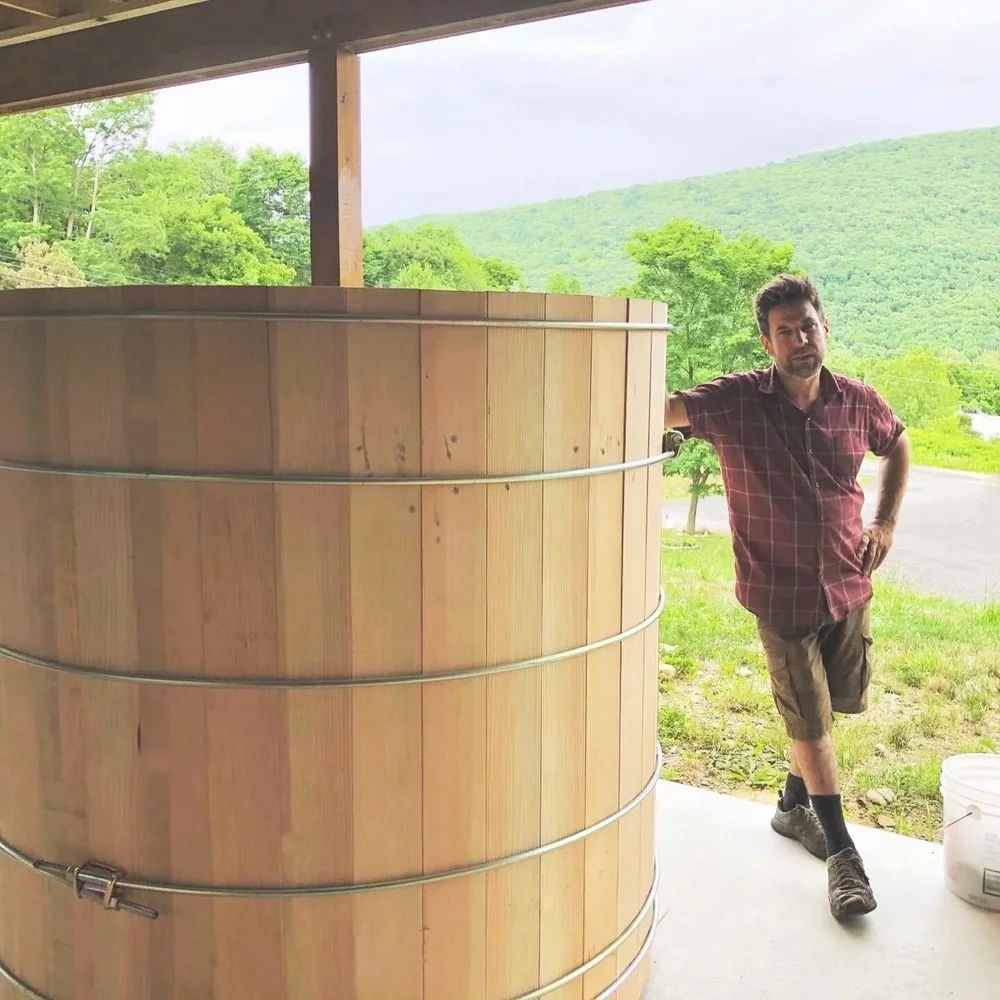
How a hot tub wood fire actually works: two heater designs
Every wood-fired hot tub system does the same thing: combustion heats a metal surface, that surface transfers BTUs to water. The difference is where that surface sits relative to the tub.
Internal submerged heater
A stainless or copper firebox sits inside the tub, partially or fully submerged. You load wood through a door that extends above the waterline, and the fire burns inside a sealed combustion chamber while the outer surface of the chamber heats the surrounding water directly. Heat transfer is immediate and efficient — no plumbing loop, no pump, no moving parts. On a 400-gallon cedar tub starting at 55°F groundwater temp (common in April in Columbia County), a well-fed internal heater running seasoned oak will reach 100°F in about 2.5 hours.
The downside I've seen on jobs: ash management. If the firebox door seal degrades, you get ash in the water. Inspect the door gasket every season. Also, the heater occupies interior volume — roughly 15–20 gallons of displacement — which matters in a two-person tub.
External side-arm heater (thermosiphon)
The firebox sits outside the tub entirely. Cold water exits a low port on the tub, passes through a coil or jacket surrounding the firebox, heats up, and returns through a high port. No pump required — the density difference between hot and cold water drives circulation naturally. This is thermosiphon convection, the same principle used in early home heating systems.
Plumbing it correctly matters. The return port must be higher than the exit port by at least 6 inches, and the pipe run should be as short and straight as possible to minimize friction loss. I've seen DIY installs where the return line dips below the exit line — the thermosiphon stalls and you wonder why the tub isn't heating. It's basic physics, not a defective heater.
External heaters add 30–60 minutes to ramp-up time compared to internal units, but they keep combustion gases and ash completely separated from your soak water, and they're easier to reload without leaning over the tub.
For a deeper look at how wood tubs are built around these systems, see our cedar hot tubs pillar guide.
Ramp-up time: the honest numbers
Marketing copy loves to say "heats in 1 hour." That's possible only under ideal conditions: small tub (under 200 gallons), starting water near 70°F, large firebox, bone-dry hardwood. In the Hudson Valley, those conditions rarely stack up together.
| Tub volume | Starting water temp | Heater type | Estimated ramp-up |
|---|---|---|---|
| 250 gal | 55°F | Internal submerged | 1.5–2 hrs |
| 400 gal | 55°F | Internal submerged | 2.5–3.5 hrs |
| 400 gal | 55°F | External thermosiphon | 3–4.5 hrs |
| 500 gal | 45°F | External thermosiphon | 4–6 hrs |
The 45°F starting temp in the bottom row is realistic for a tub filled from a well in February in Greene County. Plan accordingly. Light the fire two hours before you think you need to, not thirty minutes before.
Ambient air temperature matters too. A cedar stave tub loses heat through the walls. At 15°F outside, you're fighting convective loss the whole time you're heating. This is where cedar's natural insulating properties — roughly R-1.5 per inch of stave thickness — earn their keep compared to a thin aluminum shell. Still, in sustained cold, keep a fire going or cover the tub between uses.
Fuel: what to burn, what to avoid, and how much you need
Hardwood is the only correct answer. Oak, ash, hickory, and black locust are the best choices in this region — all grow locally and split cleanly. A cord of seasoned red oak delivers roughly 24 million BTU. A single heating session on a 400-gallon tub from 55°F to 104°F requires approximately 200,000–250,000 BTU of useful heat output, accounting for combustion efficiency around 60–70% for an open firebox. That's about 1/100th of a cord per session — less than a wheelbarrow load of split wood.
- Seasoned means 12–18 months air-dried, not "cut last spring." Wet wood burns at lower temperatures, produces more creosote, and cuts your effective BTU output nearly in half.
- Split to 4–6 inch diameter for the firebox opening on most heater designs. Rounds don't burn efficiently in a small firebox.
- Avoid softwoods (pine, spruce) as a primary fuel — high resin content, rapid burn, and creosote buildup in the flue. A few pieces of dry pine to start the fire is fine.
- Never burn treated lumber, pallets, or plywood. Combustion byproducts from treated wood include arsenic compounds and formaldehyde. This is not a minor concern.
- Store wood under cover, off the ground, with airflow. A tarp thrown over a pile on the ground is not storage — it traps moisture.
If you're sourcing locally, Dutchess and Columbia counties have several small-scale firewood operations. Buy in full cords, not face cords, and ask when it was cut.
Are wood-fired hot tubs any good? When wood fire beats electric in the Hudson Valley
The honest answer is: it depends on how you use a hot tub. Wood-fired heating is genuinely better than electric on several specific dimensions, and worse on others. Here's where I've seen it win on actual installations.
Where wood fire wins
- Off-grid or limited electrical service. Many older properties in Greene and Ulster counties have 100-amp panels already loaded. Running a 240V, 50-amp electric heater on top of existing loads is a real problem. A wood-fired system needs zero amps.
- Power outages. We lose power in this region. A wood-fired tub works during an ice storm. An electric tub with a frozen control board does not.
- Operating cost over time. At current New York State residential electric rates (~$0.22/kWh), heating a 400-gallon tub electrically costs $8–$14 per session. A wheelbarrow of local hardwood costs a fraction of that if you're buying in bulk.
- The ritual. I'll say it plainly: building a fire, watching it catch, and soaking under stars while smoke rises is a different experience than pressing a button. That's a real value, not a marketing claim.
Where electric wins
- Convenience. Set a thermostat, walk away. Electric heaters maintain temperature automatically. Wood fire requires your attention every 30–45 minutes during heat-up.
- Precise temperature control. You can overshoot 104°F with a hot fire if you're not monitoring. Electric holds 102°F exactly.
- HOA or fire-restriction situations. Some properties in the Hudson Valley have deed restrictions or seasonal burn bans. Check before you commit.
For a full comparison of heating systems and tub materials, see our cedar vs. acrylic guide. And if you're weighing the Japanese soaking tradition — where wood-fired heating has centuries of history — our Japanese soaking tub page covers the ofuro context in detail.
Plumbing, installation, and what to get right the first time
A wood-fired cedar tub is simpler to install than an acrylic spa, but "simpler" doesn't mean "improvise as you go." These are the details that matter.
Site and clearance
The firebox flue needs 18 inches of clearance from any combustible structure — cedar decking, pergola posts, fence boards. On a job in Rhinebeck last summer, a customer had planned the tub tight against a cedar privacy fence. We moved it 24 inches and avoided a fire hazard. Check your local fire code; most Hudson Valley municipalities follow NFPA 211 for solid-fuel appliances.
Drainage
You need a drain path. A 400-gallon tub draining onto a lawn is fine in summer; in February, that water will freeze and create an ice sheet. Plan a drain line to daylight or a dry well before installation, not after.
Fill source
Well water in this region often runs 45–55°F and may have iron or hardness issues that affect water chemistry. Test your source water before you fill. High iron will stain cedar staves and complicate sanitizer chemistry.
Cover
A well-fitted insulating cover is not optional. Between sessions, an uncovered tub in January loses heat fast enough that you're essentially starting from scratch every time. A 2-inch foam-core cover with a tight perimeter seal pays for itself in fuel savings within one winter season.
See our maintenance guide for seasonal care specifics, and our cedar hot tub cost page for a realistic budget breakdown including installation.
Water care in a wood-fired tub: what changes, what doesn't
I hear this assumption regularly: "It's a wood-fired tub, so it's more natural — I don't need to worry about chemicals." That's wrong, and it leads to biofilm, algae, and water that isn't safe to soak in.
What does change with a wood-fired cedar tub:
- Cedar's natural compounds — cedrol, thujopsene, and related sesquiterpenes — have documented antimicrobial properties. They slow microbial colonization on the stave surfaces. This is real chemistry, not folklore.
- Without a recirculating pump running 24/7, water movement is lower between sessions. Stagnant warm water grows bacteria faster. If you're not soaking for several days, either drain or maintain sanitizer levels actively.
- Wood-fired tubs are typically drained and refilled more frequently than electric tubs — every 1–3 months depending on bather load — because they often lack the filtration systems that extend water life in conventional spas.
What doesn't change:
- pH still needs to stay between 7.2 and 7.8. Outside that range, sanitizers lose effectiveness and the water becomes uncomfortable.
- Total alkalinity should run 80–120 ppm as a buffer against pH swing.
- Sanitizer — bromine or non-chlorine oxidizer — is still required. Test weekly minimum, after every heavy use session.
For a complete water care schedule specific to cedar stave construction, our maintenance guide has the full protocol. And if you're still deciding between tub types, browse our cedar hot tub models to see how different configurations handle these systems.
Questions about your specific site? Schedule a consultation — I'm happy to walk through heater selection, plumbing layout, and water source issues before you commit to anything.
